
Tiny House Office Conversion: Shed vs. Mobile Van Workspace
Explore tiny house office conversion options: backyard shed offices with mini splits or mobile van workspaces, costs, comfort, and permits explained.
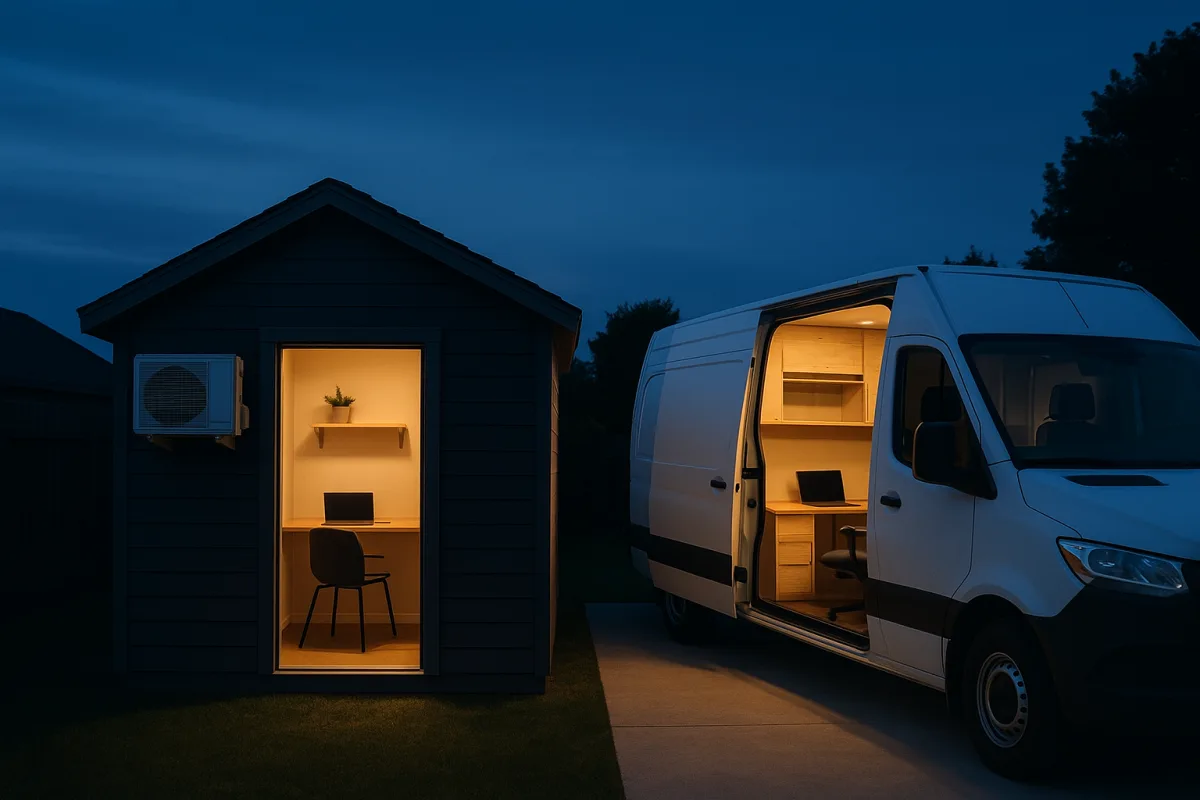
Tiny House Office Conversion: Backyard Shed With Mini Split or Mobile Van Workspace?
The decision: a fixed shed office or a mobile van office?
The practical choice here is between a backyard shed converted into a dedicated office and a professionally converted cargo van used as a mobile workspace. They solve different problems, despite both fitting within the broad small-space category.
For the fixed option, consider the Oregon shed office documented by Tiny House Expedition, fitted with a Della Vario Series 9,000 BTU mini split. For the mobile option, consider Titan Vans’ Colorado-built Sprinter and Ford Transit conversions, reported by Tiny House Talk.
This is not a close comparison if your main goal is a comfortable place to work five days a week. A shed office wins on usable space, quiet, desk ergonomics, and predictable climate control. A van wins only when you genuinely need to take the office with you.
That distinction matters because it prevents a common small-space mistake: buying mobility, premium vehicle hardware, and compact cabinetry when what you actually need is a separate room behind the house.
Head-to-head comparison
| Criteria | Converted shed office with mini split | Titan Vans mobile workspace conversion |
|---|---|---|
| Primary strength | A dedicated, stationary room separated from household noise and distractions | A workspace that can travel to job sites, clients, events, or remote locations |
| Main limitation | It stays where it is and may require foundations, permits, and utility trenching | It is expensive, compact, and still tied to parking, fuel, vehicle maintenance, and road access |
| Starting structure cost | Shed prices cited in the research brief range from $4,745 for an 8-by-16 shed to $13,645 for a 12-by-40 shed, before conversion work | Titan Vans’ Classic conversion starts at $44,995, Metis at $74,995, and Ultra at $88,995, excluding the base van [7] |
| Heating and cooling | A 9,000 BTU mini split can heat, cool, and dehumidify a small insulated office | Vehicle HVAC can support travel use, but a parked van workspace must manage sun gain, battery draw, ventilation, and limited interior volume |
| Workspace comfort | Better potential for a full desk, task chair, monitor setup, storage, and video-call background | Best for laptop work, short sessions, field work, or a compact single-person desk arrangement |
| Utility needs | Usually needs electrical supply, and may need internet, trenching, drainage planning, and a suitable foundation | Needs charging strategy, battery capacity, vehicle electrical systems, and often shore power or solar planning |
| Permitting and compliance | Structural changes and HVAC work commonly require local review, with code rules varying by city and state [2] | Vehicle conversion requirements differ from building codes, but parking and local overnight-use rules may still matter |
| Financing | Often relies on cash, personal loans, or home equity rather than a conventional mortgage | RV or specialty financing may be possible, although conversion financing is niche and usually requires stronger borrower qualifications [3] |
| Best user | Remote worker with stable housing and a long-term backyard | Contractor, photographer, traveling professional, field worker, or someone who already needs a van |
| Poor fit | Renters, people without backyard access, or anyone who expects to relocate soon | Buyers seeking the lowest-cost way to get a quiet, daily office |
Cost: the shed is not cheap, but the van is in another category
A shed conversion has several costs that get overlooked because the basic shell can appear inexpensive. The research brief places 2026 shed prices between $4,745 for an 8-by-16 model and $13,645 for a 12-by-40 model before insulation, interior finishes, wiring, HVAC, delivery, and site work.
That range does not mean every cheap shed is ready to become an office. A light-duty storage shed may need floor reinforcement, moisture protection, insulated walls, better doors, windows, electrical upgrades, and a properly prepared base.
The Tiny House Expedition shed office was only 160 square feet, a useful size for one or two people working at separate times. That scale leaves room for a desk and studio functions without becoming a second dwelling that is costly to heat and furnish.
For cooling and heating, the channel selected a Della Vario Series 9,000 BTU mini split. The unit was described as suitable for spaces up to 400 square feet, meaning it was intentionally oversized relative to their 160-square-foot shed.
That choice can make sense in a high-desert climate with hot summers and cold winter swings, but it should not be copied blindly. Proper equipment sizing depends on insulation, windows, ceiling height, local weather, solar exposure, and how much heat computers produce.
Tiny House Expedition quoted roughly $750 for the Della unit and another $100 to $150 for its DIY rental kit. The independent research brief qualifies that number: exact current public pricing for that model could not be confirmed.
For planning purposes, comparable 9,000 to 12,000 BTU single-zone systems typically cost $700 to $1,500 for equipment alone. A DIY-friendly installed setup, including parts, tools, and limited professional help, is estimated at $1,200 to $3,000 in 2026.
That installed estimate still does not include bringing a new electrical circuit to the shed, repairing wall finishes, building a condenser pad or stand, or permit fees. Those are the small line items that turn a supposedly simple climate-control project into a larger one.
The Titan Vans route starts at a much higher number. Tiny House Talk reported the Boulder company’s Classic conversion at $44,995, Metis at $74,995, and Ultra at $88,995, with all three available on Mercedes Sprinter or Ford Transit platforms.
Those are conversion-only prices, not turnkey vehicle prices. The independent research brief puts new Mercedes Sprinter cargo vans at roughly $49,000 and used Ford Transit 148-inch vans between about $25,000 and $60,000, depending on condition and specification.
Put plainly, even the entry-level Titan Vans Classic can become a roughly $75,000 project before common upgrades. Higher-spec combinations can go well beyond $100,000, and the research brief places typical turnkey van conversions between $75,000 and more than $200,000. [7]
A van also has continuing ownership costs that a backyard shed does not: registration, insurance, tires, servicing, fuel, and depreciation. Tiny homes on wheels often recover only 50 to 70 percent of build cost at resale, though no reliable 2026 resale data exists specifically for mobile offices. [6]
Heating, cooling, and power: the shed has the easier job
A backyard shed can use household-style HVAC because it is fixed in place. The mini split featured by Tiny House Expedition provides cooling, heating, and dehumidification in one compact system, without consuming floor space like a portable air conditioner.
The installation still is not as simple as hanging a window unit. The channel’s process involved wall mounting, drilling a roughly 2.5-inch penetration, routing drain and refrigerant lines, vacuuming the system, checking for leaks, and completing electrical connections.
The DIY kit reduced some specialist steps, but it did not eliminate the need for careful work. Tiny House Expedition specifically advised hiring an electrician if the installer is uncomfortable with electrical connections, which is sensible advice rather than a sign of failure.
For a shed office, comfort depends as much on the envelope as the appliance. Insulate the floor, ceiling, and walls first. Shade west-facing glazing, seal air leaks, and avoid treating a mini split as a cure for an uninsulated storage building.
A van has a harder thermal problem. Its metal shell absorbs summer heat quickly, its glass area can create serious solar gain, and its interior is much smaller. You can condition it, but the workspace remains vulnerable to weather and parking orientation.
The Titan Vans conversion families are better understood as flexible vehicle platforms than substitutes for a conditioned backyard room. The Classic suits a buyer prioritising the most accessible entry price, while the Metis and Ultra suit buyers willing to pay more for increasingly elaborate builds.
That does not make the Classic a bargain office. It is the lower-priced Titan option at $44,995 before the vehicle, and it makes sense for someone who already needs a work van. It does not make sense solely to escape a noisy spare bedroom.
Space and work ergonomics: do not underestimate the chair
The desk is rarely the main issue in tiny offices. The chair, monitor position, elbow room, door swing, storage, and background noise determine whether you can work there for eight hours without resenting the decision.
A 160-square-foot shed has enough room to plan around a real desk rather than a fold-down compromise. It can accommodate a proper task chair, filing cabinet, shelves, printer, and perhaps a small recording or creative-work area.
It also separates work from home. That benefit is hard to price, but it is often the strongest case for a backyard office. Denver-based Studio Shed reported a 150 percent sales increase in backyard office demand during the pandemic period, although current nationwide 2026 demand data is not available. [1]
The van workspace is inherently more constrained. It can be excellent for laptop work between appointments, site documentation, editing on location, or working from a trailhead with connectivity. It is less convincing as a permanent dual-monitor office.
A mobile office also needs a realistic parking plan. A driveway is not always a quiet workspace, and public parking may bring noise, heat, security concerns, unreliable internet, and restrictions on extended occupancy.
Permits, foundations, and financing are where plans get real
Neither option should be treated as a casual weekend project with no regulatory consequences. Shed conversions can trigger zoning, structural, electrical, and mechanical requirements, especially when you add permanent wiring and heating or cooling equipment. [2]
The research brief notes that local rules commonly draw from the International Residential Code and International Mechanical Code, then modify them at the state or municipal level. Requirements can include continuous footings on undisturbed soil or engineered fill, which many delivery sheds lack.
That does not mean every office needs a full residential foundation. It means you should ask the local building department before buying the structure, not after it has been dropped in the yard and wired.
Financing deserves equal caution. Traditional mortgages generally do not fit these projects well. Personal loans can reach roughly $50,000 but may carry 8 to 15 percent interest, while home equity borrowing may offer lower rates to homeowners with available equity. [3]
Builder financing may be available for some conversion purchases, but rates in the research brief range from 9.99 to 13.99 percent. A costly van conversion financed at those rates is a very different purchase from a modest backyard shed paid for gradually. [4]
Who each option suits
The shed office with a mini split suits the remote employee, freelancer, maker, tutor, or small business owner who has stable housing and needs a reliable, daily workroom. It is the better fit when quiet, comfort, a proper desk, and lower total cost matter more than mobility.
It falls down for renters, people without a usable yard, and homeowners in places with restrictive setbacks or accessory-structure rules. It also disappoints buyers who underestimate site preparation, electrical work, permitting, and the cost of making a storage shell genuinely comfortable.
A Titan Vans Classic conversion suits a buyer who already needs a Ford Transit or Mercedes Sprinter for travel or work and wants the lowest entry point in that builder’s lineup, starting at $44,995 before the vehicle. [7]
Titan Vans’ Metis conversion, starting at $74,995 before the van, suits a buyer who wants a more substantial mobile setup and has accepted that the project is a premium vehicle purchase rather than a cheap office. [7]
Titan Vans’ Ultra conversion, starting at $88,995 before the van, suits buyers with the budget for the most upmarket option in the published lineup. It is difficult to justify as a desk on wheels alone, but it can fit a work-and-travel life where the vehicle has value beyond office hours. [7]
For most people choosing only between these two paths, the honest winner is the shed office. It offers more usable workspace for far less money, and a mini split can make it a year-round room if the shell, wiring, and permits are handled properly.
The van wins for the narrower group whose work genuinely moves. If your office must follow construction jobs, photo assignments, client visits, seasonal travel, or remote projects, the higher price buys capability a backyard structure cannot provide.
Frequently Asked Questions
What are the pros and cons of a tiny house office conversion?
A shed office offers a quiet, dedicated workspace with better desk ergonomics, more space, and predictable climate control, making it ideal for full-time use near a home. However, it requires permits, a foundation, utility connections, and is stationary. A mobile van workspace provides mobility and can travel to job sites but is more compact, expensive, and less comfortable for long sessions.
How much does it cost to convert a shed into a tiny house office?
Basic sheds range from about $4,745 to $13,645 before conversion. Adding insulation, interior finishes, wiring, HVAC, delivery, and site work can significantly increase costs. A 9,000 BTU mini split system typically costs between $700 and $1,500 for equipment, with total installed costs estimated at $1,200 to $3,000 for a DIY-friendly setup, though actual prices vary by region and installation complexity.
Is a mobile van workspace better than a backyard shed office?
A mobile van workspace is better only if mobility is essential to your work, such as traveling to clients or remote locations. For a stable, quiet, and comfortable full-time office, a backyard shed is usually the better choice due to more usable space and better climate control. Vans are more compact, expensive, and require vehicle maintenance and parking considerations.
What HVAC options work best for a tiny house office?
A 9,000 BTU mini split system is suitable for a small insulated shed office up to about 400 square feet, providing heating, cooling, and dehumidification. Vehicle HVAC systems support travel needs but must manage challenges like sun exposure, battery usage, and limited interior volume. Proper sizing depends on insulation, climate, and office use.
What permits are needed for a tiny house office conversion?
Permits are generally required for structural alterations, electrical work, and HVAC installations, with mechanical permits specifically for HVAC. Building codes and permit requirements vary widely by jurisdiction, often based on the International Residential Code with local amendments. It is essential to consult local building departments or licensed professionals for compliance.
How we researched this
This article was assembled from 1 video source, 1 published article, 7 cited references.
Nothing here is based on hands-on testing. Where a figure or finding appears, it belongs to the source cited beside it, and the writing says so rather than implying otherwise. Every source is listed below so you can check it.
Sources
How We Installed an Ultra DIY-Friendly Mini Split in Our Shed Office — Tiny House Expedition
Titan Vans in Boulder: Sprinter and Transit Conversions from $44,995 — Tiny House Talk
Can You Make a Shed Into a House? Zoning Laws and Permits - LegalClarity
Tiny Home Financing — RV Loans, Personal Loans & Mortgage Options (2026)
How to Finance a Tiny Home: Every Option Explained (2026) | Tiny Amazon Homes
Do Tiny Houses Hold Their Value? Resale Reality in 2025–2026
Watch Tiny House Office and Workspace Conversions on Youtube
Related Articles
Creative Tiny House Builds and Personal Stories
Explore creative tiny house builds and personal stories, including shed conversions, scrap material use, costs, and legal tips for self-built homes.
Prefab Backyard ADUs: Costs, Permits, and Installation Guide
Learn about prefab backyard ADUs, including costs, permits, installation, and financing to plan your small backyard housing project effectively.
Prefab Tiny Homes and ADUs
Explore prefab tiny homes and ADUs with modern designs, costs, legal tips, and site considerations for small footprint living.
Small Space Decluttering Tips for Tiny House Organization
Discover practical small space decluttering tips to organize your tiny house efficiently and maintain a clutter-free home.