Small Space Decluttering Tips for Tiny House Organization
Discover practical small space decluttering tips to organize your tiny house efficiently and maintain a clutter-free home.
Start with the spot that proves your system has failed
Most small homes do not become stressful because every cabinet is full at once. The trouble starts at the drop zones: a chair collecting clothes, the counter collecting mail, or a bench becoming a holding area for bags and coats.
Apartment Therapy points out that clutter can accumulate in places we stop noticing, including the familiar “clothes chair.” In a tiny house, that same pile can block circulation, cover seating, or turn the only spare surface into permanent storage.
Do not begin by emptying every drawer in the house. Start with the place that catches items between use and put-away. Watch it for several days and identify what actually lands there: worn-once clothes, paperwork, charging cables, groceries, or dog gear.
Then give each category a nearby destination that takes less effort than making the pile. A hook by the door, a shallow tray for incoming paper, or a lidded bin for charging gear can work, but only if it is close to the problem.
This is a practical distinction worth making. Storage is not automatically organization. If the same item repeatedly lands on a chair, adding an attractive basket across the room will not solve much. The item needs a realistic home on its natural route.
Empty one problem category, not the entire house
A full-house purge is satisfying on camera, but it can be a punishing way to start in 200 square feet. Decluttering can bring guilt, fatigue, and regret, particularly where belongings carry memories or represent money already spent. [12]
The Living Your Life Channel’s apartment reset offers a useful method for preventing endless deliberation. The creator worked room by room, but dealt with a single category at a time, beginning with clothing before moving to toiletries, office clutter, and kitchen items.
For a small home, begin with a low-emotion category where the waste is obvious: expired pantry goods, duplicate cleaning supplies, mystery cables, old manuals, or empty product boxes. These give you space quickly without forcing major personal decisions on day one.
Keep the work contained. Put a laundry basket, a donation bag, recycling, and trash nearby. If you pull everything out of a loft cupboard or under-bed drawer, finish that zone before opening another. In a small home, half-finished sorting blocks daily life fast.
The aim is not to own as little as possible. The creator behind Living Your Life Channel explicitly separates being organized from being minimal. That is a sensible distinction for tiny-home living, where specialized gear may earn its footprint if it is used consistently.
Make decisions based on current life, not potential
When every item is in your hand, ask whether you still like it, whether you actually use it, and whether guilt is keeping it around. Those were the three questions used in the Living Your Life Channel reset, and they work because they expose different problems.
“I might use it someday” is not the same as current usefulness. A mini blender that has sat on a high shelf for a year is not helping because it is technically functional. It is consuming accessible storage and asking you to maintain it.
The guilt question matters most with costly items. A shirt can be well made, expensive, and still wrong for your body or routine. Keeping it because it cost money does not recover the money, but selling, donating, or passing it along may give it a useful second life.
For clothes, pull out pieces that need a try-on, but do not make every decision a long negotiation. The Living Your Life Channel creator separated out garments that had “potential” to assess later, while immediately removing obvious non-fits, redundancies, and unworn styles.
Apartment Therapy similarly advises taking stock of closet items that are no longer loved, no longer suit you, or are beyond repair. In a tiny closet, that is not just aesthetic housekeeping. It makes the clothes you do wear easier to see and retrieve.
A practical limit is better than an aspirational capsule wardrobe. If you regularly rotate five or six bags, as the Living Your Life Channel creator found, store those where they are reachable. Sell, donate, or rehome the bags that have not earned a turn.
Treat sentimental belongings differently from expired shampoo
Do not mix emotionally difficult keepsakes into a session meant to clear bathroom drawers. Sentimental clutter is where a useful afternoon becomes exhausting, and forcing quick decisions can leave you regretting the process rather than maintaining the result. [12]
Start with neutral areas first, then return to mementos once you have built some decision-making momentum. For sentimental categories, choose a top tier rather than trying to justify every item. Keep the letters, photographs, or objects that genuinely tell the story.
Use a clearly dated maybe box for uncertain items. Seal it, store it in the least convenient appropriate location, and revisit it after a defined period. If you did not retrieve anything, that is better evidence than a theoretical promise to use it.
Take photographs of bulky objects when the memory matters more than the object itself. This is especially useful in a tiny house for inherited furniture, children’s artwork, or hobby equipment that cannot reasonably fit your present layout.
Decluttering may support emotional regulation and can complement treatment for anxiety, depression, ADHD, and trauma, but it is not treatment by itself. [11] If sorting brings up grief, shame, or panic, stop for the day instead of treating distress as a failure.
Build storage around frequency, reach, and airflow
Once you have reduced the obvious excess, organize what remains by how often it is used. Daily items deserve the most convenient storage. Weekly or seasonal items can go higher, lower, or farther away, provided they remain easy to inspect.
Floor-to-ceiling shelving and high wall shelves make sense for seldom-used possessions in a tiny home. [2] They are less useful for daily cookware or toiletries, because needing a step stool for routine tasks turns organization into friction.
Put a hard limit on what goes up high. Tall ceilings invite out-of-sight accumulation, a problem the Living Your Life Channel creator found in an apartment kitchen. Label bins facing outward and review high shelves at least once a year.
Under-bed boxes or drawers can use otherwise wasted volume, while toe-kick drawers under kitchen cabinets can store flat, occasional items. [5] Keep the contents narrow and specific, such as linens, baking sheets, or pet supplies, rather than creating a broad “miscellaneous” vault.
Multifunctional furniture is worth considering only when it replaces a real storage need. Murphy beds can free floor area when folded up, and storage benches provide concealed compartments. [3] Measure clearance first, including the space needed to open drawers, lids, and fold-down mechanisms.
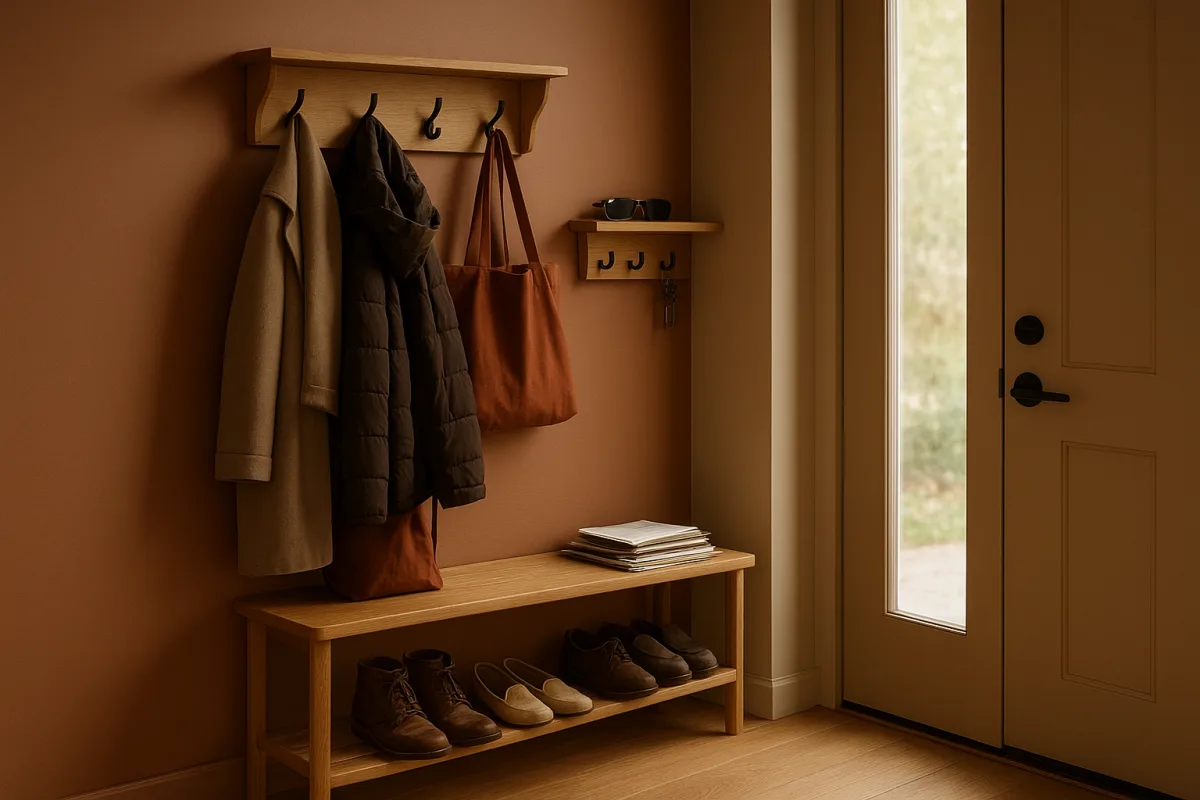
A storage bench near an entry can contain footwear or outdoor layers while providing a place to sit. Designers cited by Homes & Gardens recommend double-duty furnishings because they add storage without requiring a large furniture footprint. [4]
Fix the kitchen before buying containers
Small kitchens become messy because too many tasks compete for too little counter space. Before buying organizers, remove expired food, duplicates, appliances that are never used, and serving pieces you forgot existed. That is the same pattern identified in the Living Your Life Channel kitchen clear-out.
Assign drawers by task, not by vague categories. Put prep tools together, cooking tools together, and food-storage containers together. Drawer organizers can stop utensils and small gear from spreading through the drawer whenever it opens. [13]
An over-the-sink extendable rack or chopping board can create temporary prep space without claiming a permanent section of counter. [13] It suits a galley kitchen or tiny-house sink run, but measure the sink width and faucet clearance before ordering anything.
Toe-kick drawers are better for shallow, durable items than for frequently used utensils. [6] Think trays, placemats, baking sheets, or spare dish towels. If you have to kneel and rummage every day, that drawer is holding the wrong category.
Avoid storing groceries or cookware in places you cannot monitor. Food forgotten on top shelves expires, and heavy pans stored too high create a real injury risk. High storage is for light, clearly labelled, low-frequency items, not for things needed every week.
Use renter-friendly fixes, but check permission before altering anything
For renters, over-door organizers and self-adhesive hooks can add useful storage without drilling into walls. [13] They are particularly suited to bathroom supplies, cleaning tools, shoes, and lightweight entry items where built-in storage is scarce.
Do not assume every removable-looking product is consequence-free. There is no comprehensive national 2026 rulebook for storage changes inside rentals or tiny houses. Permission and restrictions are usually governed by your lease, local codes, or the specific construction of the home.
Check whether an over-door unit prevents a door from closing properly, whether adhesive is allowed on the wall finish, and whether shelving compromises a required exit path. In a tiny home, never block windows, loft egress, electrical panels, or ventilation routes.
Tiny homes also need careful moisture management. Money notes that limited space can allow clutter to become a hazard, while tiny-home mold problems can stem from insulation and airflow issues. [7] Do not pack vents, wall heaters, or under-bed areas so tightly that air cannot circulate.
Keep the reset from quietly reversing
The maintenance problem is usually not lack of motivation. It is that new purchases, laundry, mail, and hobbies keep entering a home with limited slack. A useful system has to handle incoming items, not merely display the things already there.
Adopt a pause before buying containers or furnishings. Ask what will be stored, where it will live, how often it is used, and what you are willing to remove to make room. Otherwise, organizers simply become more possessions to manage.
Set a small recurring reset for the pressure points: return clothes from the chair, clear the sink area, empty the entry tray, and put loose cords back in their designated spot. This is more realistic than waiting for another all-day purge.
For possessions leaving the house, create an exit plan immediately. Donation bags should go to the car, sale items need a deadline, and recycling should leave promptly. A pile of decluttered goods by the door is still a pile in a tiny home.
If you need outside help, get specific about the job. Professional organizers typically cost $50 to $150 per hour nationally, while experienced organizers in major cities may charge $100 to $200 or more. [1] A single-room project commonly runs $200 to $500, before any bins, furniture, hauling, or specialty services. [1]
That expense can make sense for a move, a major downsizing project, or an accessibility issue, but it is not required for ordinary maintenance. The useful lesson from the sources is simpler: reduce what does not serve current life, then make the remaining items easy to put back.
Frequently Asked Questions
How do I start decluttering in a small space?
Begin by identifying the spot where clutter first accumulates, such as a clothes chair or kitchen counter. Observe what items land there over several days and create a nearby, easy-to-access home for each category to prevent piles from forming. Avoid emptying the entire house at once; focus on one problem area or category at a time.
What are effective decluttering methods for tiny houses?
Focus on clearing low-emotion categories first, like expired pantry goods or duplicate supplies, to gain quick space without emotional strain. Use three key questions for each item: do you like it, do you use it, and are you keeping it out of guilt or imagined future use? Also, ensure that added storage maintains airflow, access, and safety rather than just increasing capacity.
How can I organize daily-use items in a small home?
Place daily-use items at hand height for easy access, while reserving high shelves and under-bed compartments for occasional items. Avoid letting hidden storage become a secondary junk drawer by regularly reviewing and maintaining organization in these spaces.
What decisions help reduce clutter in tiny homes?
Decide whether you currently like and use each item, and recognize if guilt or cost is keeping it unnecessarily. Separate items with potential future use from those clearly not needed, and limit possessions to what fits your current lifestyle rather than aspirational minimalism.
How should sentimental items be handled when decluttering?
Treat sentimental belongings separately from everyday clutter to avoid emotional overwhelm. Keep only items that genuinely tell your story, use a dated maybe box for uncertain items stored out of the way, and consider photographing bulky keepsakes to preserve memories without taking up space.
How we researched this
This article was assembled from 1 video source, 2 published articles, 13 cited references.
Nothing here is based on hands-on testing. Where a figure or finding appears, it belongs to the source cited beside it, and the writing says so rather than implying otherwise. Every source is listed below so you can check it.
Sources
I Decluttered My ENTIRE Apartment in One Day No Mercy — Living Your Life Channel
How to Find the Clutter Problem Area in Your Home — Apartment Therapy
How to Declutter Your Closet Like a Professional Organizer — Apartment Therapy
Tiny Home Furniture Guide — Best Space-Saving Picks (2026) | Tiny Amazon Homes
These Are Officially the Biggest Storage Trends for Kitchens in 2026, According to Kitchen Designers
Tiny Houses: Is It the Right Downsizing Option for You? |...
Clear Space, Clear Mind: The Science Behind Decluttering | Psychology Today
The Mental Health Benefits of Decluttering: An Integrative Psychiatry Perspective
Watch Decluttering and Small Space Organization Tips on Youtube
Related Articles
Off-Grid Power Solutions for Tiny Homes: Sizing and Setup
Learn how to size and choose off-grid power solutions for tiny homes, including solar generators, battery storage, and backup power options.

Innovative Two-Bedroom Home Near Amsterdam: Modern Design & Rooftop Deck
Explore Unit Direct's unique two-bedroom home near Amsterdam, featuring a modern design, sleek black fixtures, clever construction, and a rooftop deck. Priced at €189,000, this innovative house offers style and functionality in a compact space.

Touring the Stylish Milhome 60: A Prefab Home Marvel
Explore the innovative Milhome 60 prefab home in Amsterdam with Kerry Tarnow. Discover its unique design, modern features, and versatile living spaces. Experience the perfect blend of style and functionality in this cutting-edge home tour.

Discover the Stylish Terrace Series 900 ADU in Austin
Explore the innovative Terrace Series 900 ADU by Aura Prefabs in Austin, Texas, showcased by Kerry Tarnow. This modern home features a rooftop deck, clever layout, and efficient design, offering a stylish and functional living space for downsizing homeowners.