
Off-Grid Power Solutions for Tiny Homes: Sizing and Setup
Learn how to size and choose off-grid power solutions for tiny homes, including solar generators, battery storage, and backup power options.
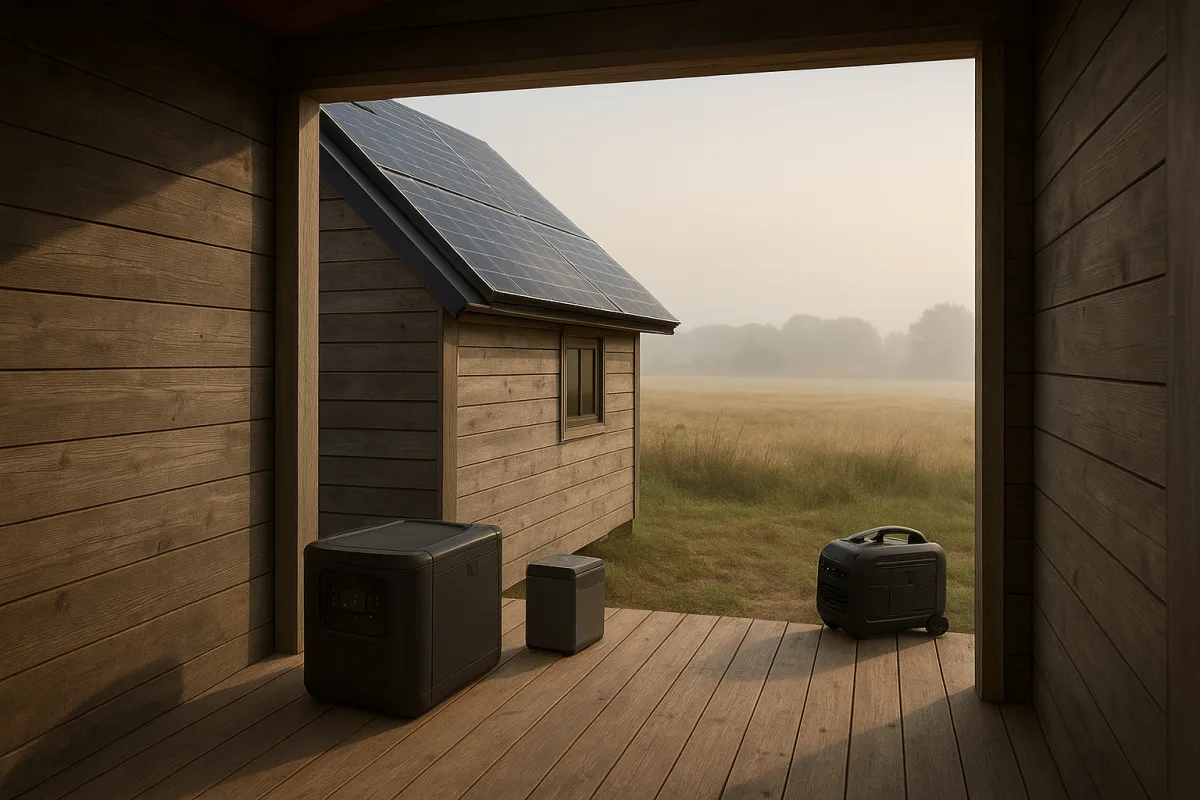
First, decide what must stay on when the grid fails
The first mistake is buying a battery by its headline watt-hours, then discovering it cannot run the things that make a tiny house livable. Start with the loads that matter during an outage: refrigeration, water, lights, communications, ventilation and medical equipment.
A portable power station is best treated as an emergency power layer. It can keep food cold and phones charged, but it does not automatically replace a utility connection or a permanent off-grid system with properly sized panels, batteries and inverter capacity.
Make a list of each appliance’s running watts, starting watts and daily hours. Refrigerators, pressure pumps and compressors briefly pull much more power at startup, so inverter surge capacity matters just as much as battery size. [2]
This is particularly important in a compact house, where one appliance can change the whole plan. A small space heater, induction hob, toaster oven or electric water heater can drain a modest battery faster than many buyers expect.
The disability-focused tiny house profiled by Tiny House Expedition is a useful example of designing around actual needs rather than fashionable off-grid features. The couple’s solar-equipped house runs a washer-dryer combo and HVAC equipment, but it also has an automatic backup generator.
That is the sensible model for a home where independence has real stakes. Their backup generator starts when batteries reach a set level, although it still needs fuel. The solar system reduces dependence, it does not eliminate the need for a contingency plan.
Choose the smallest package that covers your emergency loads
For a weekend cabin, parked tiny house with grid backup, or a first emergency kit, the Jackery Solar Generator 1000 V2 with a 200W panel costs about $599 to $699, according to Prefab Homes and Tiny House. It suits lights, charging, a router, fan and modest refrigeration.
The package includes a 1,070Wh LiFePO4 battery, 1,500W continuous AC output and folding 200W panel, according to the channel. That is an approachable scale, but do not read “mini fridge for a day” as a guarantee for every refrigerator or weather condition.
The Anker Solix C1000 Gen 2 with 200W panel costs roughly $649 to $799. Prefab Homes and Tiny House positions it as the stronger choice for a tiny-home office because it combines 1,056Wh capacity, 1,800W output and UPS-style switching.
That claimed sub-20-millisecond switchover is relevant if an outage would interrupt a computer, router or work call. The unit can accept up to 600W of solar, so it also makes sense for buyers who want a small starter kit now and more panels later.
Neither of these entry-level systems should be your only power source for an electrically heated home, regular air-conditioning or frequent cooking. Their value is portability and simplicity, not enough stored energy to ignore weather for several days.
LiFePO4 is the chemistry worth prioritising at this level. Research generally puts its service life around 3,000 to 5,000 cycles, or roughly 10 to 15 years of daily cycling, although real life depends heavily on heat, charging habits and storage conditions. [3]
When a power station becomes a real tiny-home system
The Bluetti AC200L with a 200W panel, priced around $1,099 to $1,449, is the first package in Prefab Homes and Tiny House’s list that begins to suit full-time tiny-home essentials. It has 2,400W continuous output and accepts up to 1,200W of solar input.
The included panel is not enough to exploit that charging capacity. The channel recommends adding panels, and that is the practical reading: buying a large battery with only one 200W portable panel creates a slow-recharging emergency battery, not a balanced off-grid system.
Its dedicated 30-amp RV outlet makes the AC200L a reasonable fit for a tiny house on wheels or an RV-style electrical inlet. It can also expand to 8,192Wh with extra batteries, although expansion batteries raise the final cost substantially.
The Jackery Explorer 2000 Plus, at roughly $1,599 to $2,499 with solar panels, suits buyers who need higher appliance output and want to add battery capacity over time. Prefab Homes and Tiny House lists 2,042Wh base capacity, 3,000W continuous output and expansion up to 24kWh.
That output may support a refrigerator, microwave, window air conditioner and ordinary electronics, but not necessarily all at once for long. It accepts up to 1,400W of solar, which is useful if the house has room for a more substantial portable or roof-mounted array.
The key trade-off between these mid-sized packages is not brand loyalty. It is whether your biggest problem is daily energy storage, high-wattage appliances, or a need to connect through an RV inlet or transfer switch.
Step up only when the house has larger loads
The Anker Solix F3800 with a 400W panel costs about $1,999 to $2,949 and is aimed at a serious off-grid tiny home, cabin or rural backup installation. Prefab Homes and Tiny House lists 3,840Wh capacity, 6,000W continuous output and 120V and 240V capability.
Its 2,400W solar-input limit and expansion to 26.9kWh make it more like the core of a fixed system than a grab-and-go emergency box. That does not make the package cheap, especially once additional panels and batteries are added.
Prefab Homes and Tiny House cites an independent five-week trial that ran a refrigerator, chest freezer, lights, router, laptop and fan for 12 to 18 hours on one charge. That is encouraging backup performance, not proof it will carry every tiny house through every season.
The EcoFlow Delta Pro 3 with 400W panel costs around $2,599 to $3,199. It suits a full-time tiny house with substantial battery needs, especially for owners who want app-based monitoring of loads, remaining runtime and solar production.
The channel lists 4,096Wh of battery capacity, 4,000W continuous output, 1,600W solar input and expansion up to 48kWh. It also cites a reviewer who powered a refrigerator, chest freezer, lights and router for about 14 hours from one unit.
Those figures put the Delta Pro 3 in genuine backup-system territory, but its advertised bundle includes only a 400W panel. A buyer seeking daily off-grid living needs to budget for more solar, mounting, wiring and likely expansion storage.
The Jackery Home Power 3000 600 Plus costs around $1,699 to $2,499 and suits a buyer who needs heavier-duty power but must move it regularly between a tiny house, RV, seasonal cabin or camp. Prefab Homes and Tiny House describes it as a 77-pound wheeled unit.
Portability is not a minor detail. The same channel says the Anker Solix F3800 weighs 132 pounds and the EcoFlow Delta Pro 3 around 115 pounds. A larger system can be technically portable while still being awkward to lift, secure or move alone.
Account for the costs that portable-generator prices hide
A $700 solar-generator bundle can be a good emergency purchase. It is not a substitute for the broader infrastructure required to run a fully off-grid home reliably, especially if that home needs water pumping, wastewater handling, cooling or electric heat.
For a 400 to 800 square foot tiny home, off-grid systems including solar, battery storage, water, waste and heating typically cost $18,000 to $35,000, excluding the house itself. [4] That wider figure is much closer to a realistic fully independent setup.
The DIY route can be cheaper. Research cited in the brief puts a 4 kW DIY system at $6,500 to $11,000, including approximately $4,500 to $7,000 for a 15kWh battery. Professionally installed 10 to 20kWh systems can reach $15,000 to $30,000. [3]
Those totals still do not include land, delivery, foundations, permits or utility work. The $90,000 California tiny house featured by Tiny House Expedition was a completed 26-foot custom home, not simply a power-system price, and its solar and generator package was one part of a larger build.
A low-cost self-build can look radically different. In Kirsten Dirksen’s tour, a straw-bale homesteader says his roughly 420-square-foot house cost about $15,000 in materials including the power system, with batteries once costing him about $500 each.
That build also works because it reduces demand first: heavy insulation, passive solar gain, thermal curtains, a small wood stove, rainwater collection and minimal plumbing. It is a reminder that saving electricity is usually cheaper than buying enough batteries to waste it.
Plan for bad weather, battery wear and maintenance
Solar-generator marketing usually assumes direct sun, full panels and a new battery. Your system will see cloudy weeks, panel shading, dirt, winter sun angles and storage losses. Build in battery autonomy rather than assuming each sunny day fully resets the system. [2]
Batteries and electronics are not maintenance-free. Estimated 10-year off-grid maintenance costs run about $4,500 to $7,000, excluding the initial system cost, with battery replacement potentially costing $3,500 to $10,000 and inverter-charger replacement $1,200 to $3,500. [8]
Heat, humidity and extreme temperatures accelerate battery aging. Field research has found that predictive monitoring can identify likely battery failures weeks ahead, which is useful for a home that relies on stored electricity for essential loads. [1]
Keep portable batteries in a dry, temperature-moderated location where possible. Inspect panel connectors, cable insulation and mounting hardware, clear debris and shade, and periodically test the backup generator under load rather than discovering its problem during an outage. [8]
Finally, check legal requirements before treating a plug-in system as permanent infrastructure. Utah’s HB 340 and California’s SB 868 have legalised certain plug-in solar installations up to 1,200W with less permitting friction, while UL 3700 addresses safe integration. [10]
That does not override local building, fire, zoning or utility rules. Ask the authority having jurisdiction about panel mounting, battery placement, transfer equipment and whether a tiny home on your site is considered an RV, accessory dwelling unit or something else entirely.
Frequently Asked Questions
How do I size an off-grid solar system for a tiny home?
Start by conducting a load audit listing each appliance’s running watts, starting watts, and daily usage hours. Consider essential loads during outages like refrigeration, water pumping, lighting, communications, ventilation, and medical equipment. A 1 kWh battery may cover short outages but is usually insufficient for cloudy days. Systems with about 4 kW solar capacity and 15 kWh battery storage are common for full-time tiny homes.
What portable solar generators work best for tiny houses?
Entry-level portable generators like the Jackery Solar Generator 1000 V2 and Anker Solix C1000 Gen 2, each with about 1,000 Wh capacity and 200W panels, suit emergency essentials such as lights, charging, and modest refrigeration. Mid-sized options like the Bluetti AC200L and Jackery Explorer 2000 Plus offer higher output (2,400W to 3,000W) and expandable battery capacity, better supporting full-time tiny-home needs. Choose based on your daily energy storage and appliance wattage requirements.
Can a solar generator power a tiny home during outages?
Solar generators can power essential loads like refrigeration, lights, and communications during short outages but typically cannot support electric heating, air conditioning, or laundry for extended periods. Their value lies in portability and emergency use rather than replacing a permanent off-grid system. For critical needs or longer outages, a fuel generator backup is recommended.
What are the costs of off-grid solar systems for tiny homes?
DIY 4 kW solar systems with roughly 15 kWh battery storage typically cost between $6,500 and $11,000. Professionally installed systems with 10 to 20 kWh batteries range from $15,000 to $30,000. These costs exclude the tiny home itself and depend on system size, installation type, and battery capacity. Maintenance over 10 years may add $4,500 to $7,000.
How do I plan backup power for medical equipment in a tiny house?
Include a fuel generator as part of your backup plan to ensure reliable power for medical equipment, water pumping, or heating during long outages or low solar availability. Solar generators are quiet and useful but may not recharge batteries quickly enough without good sunlight. Design your system around critical loads and consider automatic backup generators that start when battery levels are low.
How we researched this
This article was assembled from 3 video sources across 3 channels, 10 cited references.
Nothing here is based on hands-on testing. Where a figure or finding appears, it belongs to the source cited beside it, and the writing says so rather than implying otherwise. Every source is listed below so you can check it.
Sources
He built dirt-cheap homestead in sweet spot: beats city, suburb, country — Kirsten Dirksen
Couple's Off-Grid Tiny House Designed for Disabilities & Independence — Tiny House Expedition
The Best Emergency Off-Grid Backup Power You Can Buy on Amazon (No Grid Required) — Prefab Homes and Tiny House
Predicting battery end of life from solar off-grid system field data using machine learning
Tiny Home Financing — RV Loans, Personal Loans & Mortgage Options (2026)
Off-Grid Power Systems: The Complete Guide for 2026 | PowerReady
Best Solar Generators for Off-Grid Use in 2026 | The Off-Grid Workshop
Plug-in solar batteries are being legalised across the US, but when will they come to the UK?
Watch Off-Grid Power Solutions for Tiny Homes on Youtube
Also from the sources
Related Articles
Off-Grid Small Cabin Living for Families
Learn how to plan and design off-grid small cabin living for families, including layouts, power systems, and legal considerations.
Space-Saving Multifunctional Design for Small Apartments
Explore space-saving multifunctional design tips for small apartments and tiny homes to maximize storage, privacy, and usability.
Small Space Decluttering Tips for Tiny House Organization
Discover practical small space decluttering tips to organize your tiny house efficiently and maintain a clutter-free home.
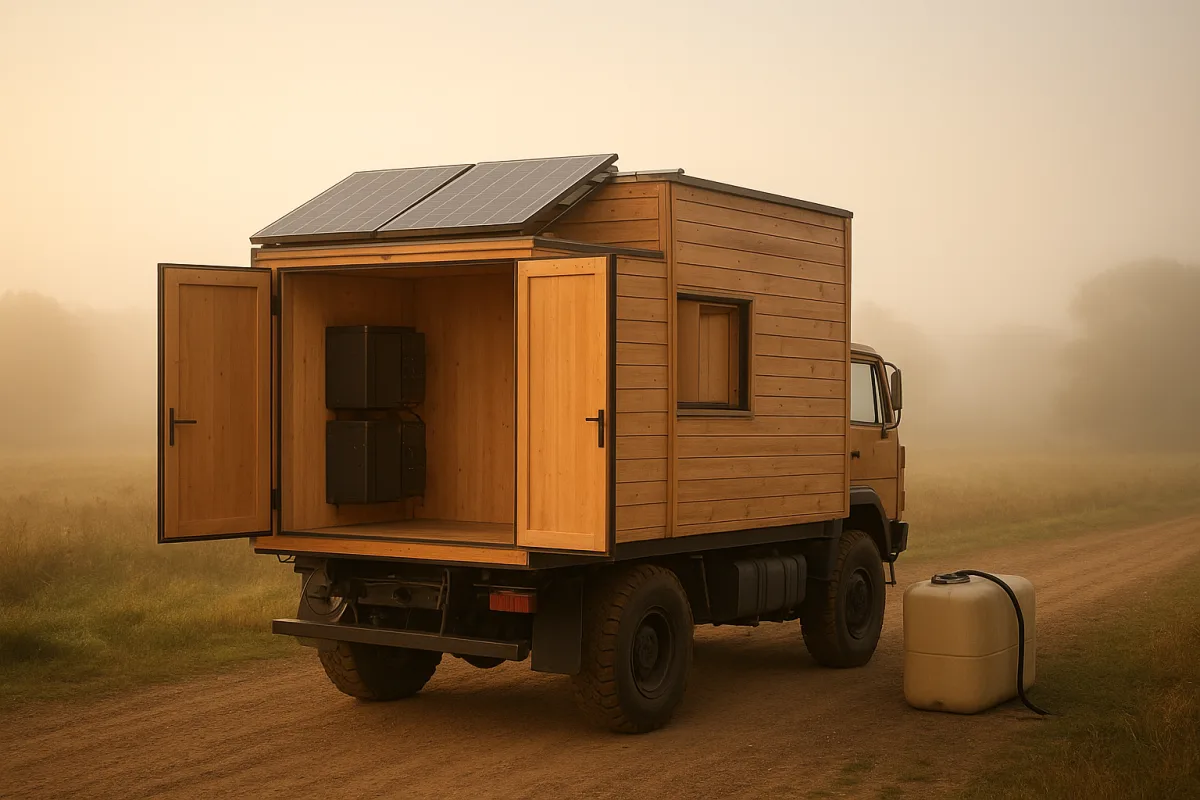
Truck-Based Off-Grid Tiny Homes: Mobile Living Innovations
Explore truck-based off-grid tiny homes, their design, costs, and mobile living systems for self-sufficient life on the road.