
Truck-Based Off-Grid Tiny Homes: Mobile Living Innovations
Explore truck-based off-grid tiny homes, their design, costs, and mobile living systems for self-sufficient life on the road.
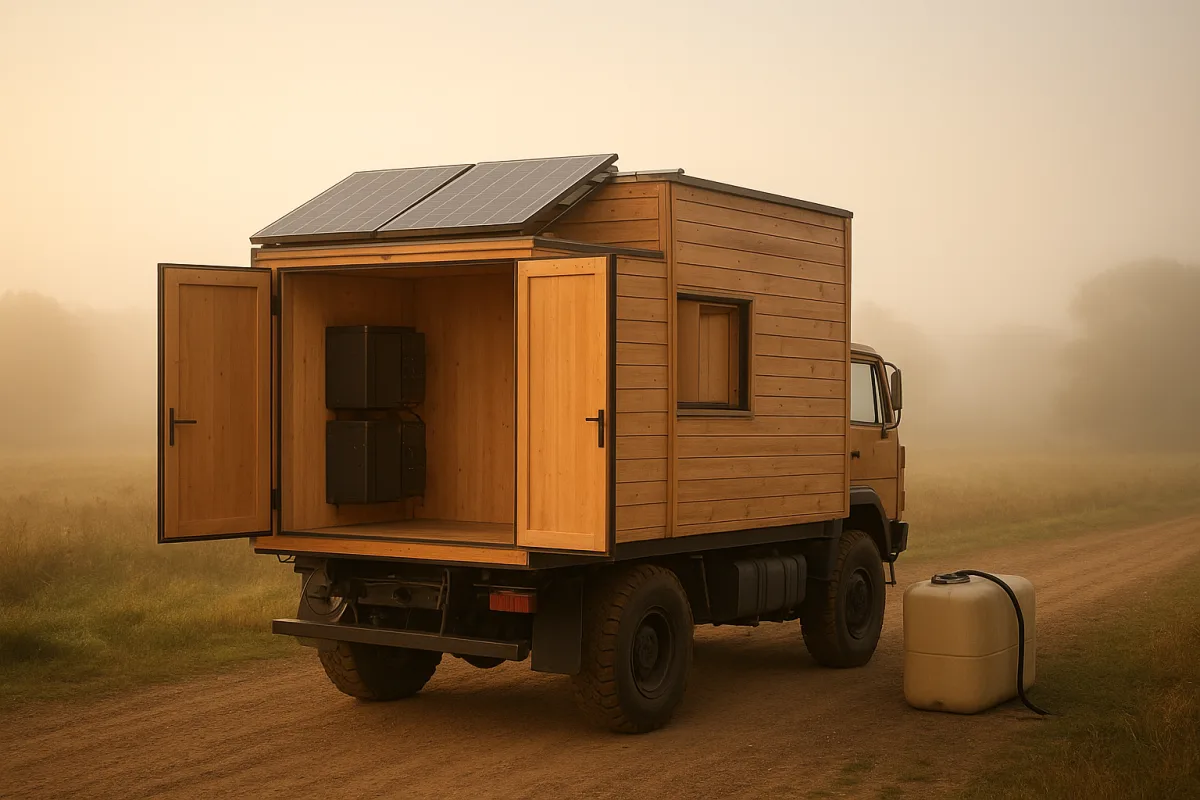
The shift is toward self-contained mobility, not just smaller homes
Off-grid tiny homes are moving beyond the familiar trailer on a rural plot. More builders are putting serious living spaces on truck chassis, combining the self-sufficiency of an off-grid cabin with the range and rough-road ability of an expedition vehicle.
The evidence is real, though it is not yet strong enough to call this a mass-market housing shift. A Canadian couple featured by Exploring Alternatives built a cedar-clad camper on a Ford F-550, while Dutch travellers Nico and Jona turned a used commercial box truck into a compact home reported by Tiny House Talk.
Those projects arrive at the same answer from different directions. One is an all-new, heavy-duty 4x4 truck for long-distance travel. The other starts with a high-mileage used delivery-style truck and prioritises an open, apartment-like living space.
That overlap matters. These are not merely vans with better interiors, nor conventional tiny houses that happen to have wheels. They are attempts to make a small dwelling capable of carrying its own water, heat, cooking, sanitation and power.
Why truck-based living is gaining attention now
The appeal is fairly straightforward. A trailer-based tiny house can provide more interior room for the money, but it is usually designed to be moved occasionally. A truck camper or box-truck home accepts less living area in exchange for more frequent movement.
The Ford F-550 build shown by Exploring Alternatives illustrates that trade. The owners chose a commercial 4x4 chassis because they wanted to travel across North and South America, carry substantial weight and use engine braking on mountain roads.
Their finished rig is about 24 feet long, 12 feet high and roughly 17,000 pounds ready to travel. Those dimensions are manageable compared with a large RV, but this is still a substantial truck, not something that slips unnoticed into a city street.
The used 2012 DAF LF 55 covered by Tiny House Talk makes the other case for the format. Its square living box gives Nico and Jona enough width for a sofa, kitchen, bathroom, wood stove and cab-over bed without the constant conversion routine common in vans.
A box body can also make furniture planning more sensible. Nico and Jona used a rotating table as desk, dining table and outdoor table, while the rear liftgate became a small deck. That is a useful example of making one expensive structural feature serve several jobs.
Still, neither build proves that truck homes are becoming common. Tours and social coverage show growing interest among experienced travellers and self-builders. They do not provide market-wide sales figures, financing data or evidence that these vehicles solve affordable housing at scale.
Off-grid systems are becoming more deliberate
The strongest common thread is not the truck itself. It is the effort to make everyday living systems work without a campground hook-up. Both households built around water storage, solid-fuel heat, compact cooking and low-demand appliances.
The F-550 camper featured by Exploring Alternatives carries about 200 to 220 litres of water, depending on which figure in the tour is used. Its owners reserve the main tank for washing and dishes, carrying separate drinking water rather than treating all onboard water as potable.
That distinction is practical. A large tank extends stays away from services, but water is heavy, roughly one kilogram per litre before allowing for the tank and plumbing. A 200-litre supply alone adds about 200 kilograms to a vehicle already carrying a house.
The same build uses 900 watts of solar panels and two EcoFlow battery banks totalling 7.2 kilowatt-hours. It also charges from the truck alternator while driving, which is an important detail often missing from aspirational solar-system descriptions.
The owners say they have not lacked electricity, but they also acknowledge that their air conditioner consumes heavily from the batteries. They are considering more solar capacity because air conditioning changes the maths quickly, particularly in hot climates or during cloudy weather.
That is the realistic lesson for prospective builders. Solar can cover lighting, electronics, water pumps and efficient refrigeration very well when the system is sized correctly. Cooling a small home electrically can be possible, but it should not be assumed from a panel count alone.
Nico and Jona’s truck, reported by Tiny House Talk, also shows how water conservation affects fixture choices. Their secondhand Nebia shower was set to 2.8 litres per minute, a low-flow approach that can make a finite tank last longer.
Their Cinderella incinerating toilet avoids a black-water tank, but it is not a no-maintenance or no-energy solution. Tiny House Talk reports that it runs on gas for around 30 to 45 minutes after each use and requires weekly cleaning.
That is the broader off-grid reality. Every system moves inconvenience somewhere else. Composting toilets require careful use and emptying, incinerating toilets consume fuel, wood stoves need dry fuel and cleaning, while conventional holding tanks require suitable disposal points.
Natural materials are appealing, but not automatically better
The F-550 camper is notable for its cedar exterior, hemp insulation, wood interior and hardwood floor. Those choices give the space a cabin-like finish that many factory RVs do not achieve, and the owners value avoiding a plastic-heavy interior.
Cedar has natural resistance to insects and decay, while hemp insulation commonly falls around R-2.5 to R-3.5 per inch. Those are useful properties, especially for someone pursuing lower-impact materials or a more breathable wall assembly.
But the evidence needs a limit. There is no direct comparative research showing that hemp-and-cedar walls outperform foam or fibreglass systems in the particular vibration, moisture and temperature conditions of off-grid truck campers.
Synthetic insulation generally produces more insulation value per inch, which matters when wall thickness is limited. Hemp may fit a builder’s material goals, but it does not eliminate the need for sound air sealing, ventilation, moisture management and a carefully designed thermal envelope.
The Exploring Alternatives owners say their ventilated wall approach has prevented condensation and provided good air quality. That is useful lived experience, but it is one build report, not a controlled durability test across climates and years of road vibration.
The real cost begins before the interior goes in
Truck-based builds can look like a clever way to avoid property costs, but the vehicle is a major capital expense. For context, 2026 Ford F-550 cab-and-chassis listings range roughly from $71,474 to $85,675, varying by drivetrain, cab configuration, location and dealer discount.
That price buys the truck chassis, not a finished home. A buyer still needs a living box, mounting system, windows, insulation, cabinetry, appliances, plumbing, batteries, solar equipment, wiring, labour and often commercial-grade tyres and suspension work.
The Canadian F-550 owners built their camper themselves with help from a friend, which likely avoided some professional labour cost. It also required construction knowledge, time and a willingness to solve unusual problems, such as securely mounting a heavy living body to a commercial frame.
At the lower-entry end, Nico and Jona bought a used 2012 DAF LF 55 with more than 600,000 kilometres already recorded. A used chassis can lower initial cost, but it makes a pre-purchase inspection and repair reserve non-negotiable.
Tiny House Talk reports fuel use of roughly 20 litres per 100 kilometres for that truck. That makes it a home that can move, not a cheap vehicle to move often. Long-distance travel needs a fuel budget alongside food, campsites, tolls and routine mechanical work.
Verified annual maintenance, fuel and insurance averages for tiny house trucks are not available. Estimates sometimes borrowed from commercial fleets, boats or aircraft are not reliable substitutes, because personal travel patterns, load weight, maintenance standards and local insurance vary too widely.
Financing is another point where tiny-house marketing can get vague. Traditional mortgages usually do not fit mobile homes on commercial chassis. Buyers may need commercial equipment finance, RV or chattel loans, personal lending, or cash, each with different rates and underwriting rules.
SBA-backed business borrowing is not a casual workaround for personal mobile living. Kiplinger reports that SBA 7(a) rules changed in 2026, including stricter underwriting and a 10 percent equity-injection requirement in relevant cases. [1]
Compliance is as important as the floor plan
The F-550 build shown by Exploring Alternatives bolts the camper permanently to the frame. That may create a sturdy package, but it also places the project in a regulatory grey area that differs by jurisdiction, vehicle classification and how the owner uses it.
There is no single nationwide framework that makes bolt-on tiny house campers automatically compliant. Federal vehicle rules address items such as coupling and road operation, but state, provincial and local agencies can still affect registration, inspections, parking and occupancy.
A truck may be road-legal yet not be legal to live in full-time on a particular parcel. Local zoning commonly restricts permanent RV occupancy, and recent state-level exceptions, including limited changes in Oregon, are unusual rather than a general rule.
Off-grid equipment can also trigger requirements. Solar, battery, generator, propane and electrical installations may need permits or inspections under local rules, while RV electrical work is generally guided by NEC Article 551. Confirm this before building walls over wiring.
The sensible order is to choose where and how you will use the vehicle, then speak with local planning staff, an RV-qualified electrician, an insurer and a vehicle-upfitting professional. The floor plan should follow those answers, not precede them.
What to borrow from these builds
Borrow the systems thinking, not necessarily the scale. The F-550 camper’s dedicated dirty-gear storage, lockable drawers and outside equipment compartments show why travel homes need to keep wet boots, hoses, tools and fuel-related kit away from living areas.
Borrow the energy discipline too. The F-550 owners use propane only for cooking, rely on a wood stove for cold-weather heat and selected an efficient freezer converted to refrigerator. Those choices reduce electrical demand before adding more batteries.
From Nico and Jona’s truck, borrow the willingness to protect open space. Their liftgate deck, sliding doors, low cab-over bed and restrained cabinetry make the box feel less crowded, without pretending it contains the storage capacity of a conventional house.
What not to borrow blindly is the idea that one impressive build offers a universal recipe. A full wood stove, rooftop tent, high-mileage delivery truck, incinerating toilet or large fixed camper can be sensible for one travel pattern and expensive overkill for another.
For a couple moving frequently, a modest truck camper with efficient systems may be the better compromise. For a mostly parked home, a trailer-based tiny house or small cabin may provide more usable space, simpler servicing and fewer vehicle-related costs.
Frequently Asked Questions
What are the challenges of living in a truck-based off-grid tiny home?
Living in a truck-based off-grid tiny home involves managing limited space and weight constraints, as well as handling the inconvenience of off-grid systems. Water storage adds significant weight, and systems like incinerating toilets or wood stoves require fuel, maintenance, and careful use. Additionally, legal and zoning restrictions may limit where such homes can be parked or lived in full-time.
How much does it cost to build a truck-based off-grid tiny home?
The cost of the truck chassis alone, such as a new Ford F-550 cab-and-chassis, ranges from about $71,474 to $85,675 in 2026. This price does not include the living box, solar and battery systems, water systems, labour, registration, or insurance, which add substantially to the total build cost.
What off-grid systems work best for mobile truck tiny homes?
Solar panels combined with battery banks are effective for covering typical electrical loads like lighting, pumps, and refrigeration. Water systems usually involve large tanks for washing and separate potable water storage. Heating often relies on wood stoves, while incinerating toilets and low-flow fixtures help manage waste and water use. However, air conditioning demands high power and requires careful planning or backup generators.
Are truck-based tiny homes legal for full-time living?
Legality varies by location and is governed by local zoning laws and permit requirements. Many places restrict permanent residence in RVs or truck homes, though some exceptions exist, such as recent laws in Oregon. Electrical and gas installations also require permits, so legality depends on local regulations and compliance.
How do solar and battery systems support off-grid truck living?
Solar panels sized around 900 watts paired with battery banks totaling several kilowatt-hours can reliably power lighting, electronics, water pumps, and refrigeration. These systems often charge from solar and the truck alternator while driving. However, high-energy appliances like air conditioners can quickly deplete batteries, making additional solar capacity or generator backup necessary.
How we researched this
This article was assembled from 1 video source, 1 published article, 1 cited reference.
Nothing here is based on hands-on testing. Where a figure or finding appears, it belongs to the source cited beside it, and the writing says so rather than implying otherwise. Every source is listed below so you can check it.
Sources
Couple's Incredible Off-Grid Truck Camper & Tiny Home on Wheels – FULL TOUR — Exploring Alternatives
Nico & Jona’s Tiny House Truck: A 2012 Dove LF 55 Tour — Tiny House Talk
SBA Loan Rules Just Changed: Here's What Could Sink Your Application in 2026
Watch Off-Grid Tiny Homes and Mobile Living Innovations on Youtube
Related Articles
Off-Grid Power Solutions for Tiny Homes: Sizing and Setup
Learn how to size and choose off-grid power solutions for tiny homes, including solar generators, battery storage, and backup power options.
Cindy's Cozy Tiny Home Tour: Financial Freedom and Travel Adventures
Explore Cindy's spacious and cozy tiny home, featuring a well-equipped kitchen, ample storage, community amenities, and a relaxing napping porch. Discover the financial benefits and freedom of tiny home living, along with Cindy's travel adventures in her travel van.

Charming Tiny Home Tour: Newport, Tennessee
Explore Dorothy Templeton's charming tiny home in Newport, Tennessee, featuring a well-equipped kitchen, cozy living area, functional bathroom, and comfortable bedroom. Discover her love for cloud-watching and the thoughtful details that make her space a true haven.
Off-Grid Water Systems for Tiny Homes Explained
Explore off-grid water systems for tiny homes, including sourcing, costs, and management tips for sustainable living.