Tiny House Land Use Options and Community Living Rules
Explore tiny house land use options, community living rules, and legal classifications to find where you can legally place and live in a tiny house.
Tiny House Communities and Legal Land Use Options: The Classification That Decides Where You Can Live
Your home’s legal category comes before the land search
You have found a tiny house you can afford, or you have a camper already. The next decision looks like land, but the first question is what the local government believes you are trying to park or build.
A tiny house on wheels is often regulated as a recreational vehicle. A small home on a permanent foundation may be a dwelling, while a detached backyard unit may qualify as an accessory dwelling unit, or ADU. [4][5]
Those labels decide the rules on full-time occupancy, hookups, setbacks, building permits, financing, and where you can legally stay. They also decide whether a promising cheap lot becomes a home site or an expensive storage yard.
Tiny House Talk identifies five common routes: a pad in a tiny-house community, an RV or manufactured-home park, private land, an ADU site behind a main home, or land without restrictive HOA covenants. Each route begins with classification.
The key paperwork for a wheeled tiny house is often its certification. Communities and lenders may ask for RVIA, ANSI A119.5, or NOAH documentation, which tells them the unit meets a specified construction or recreational-vehicle standard. [3]
That paperwork does not automatically make permanent residency legal. It can make a unit easier to insure, finance, and place in a park, but the city or county still controls whether people may live in it year-round. [3][4]
Why communities are the easiest first landing place
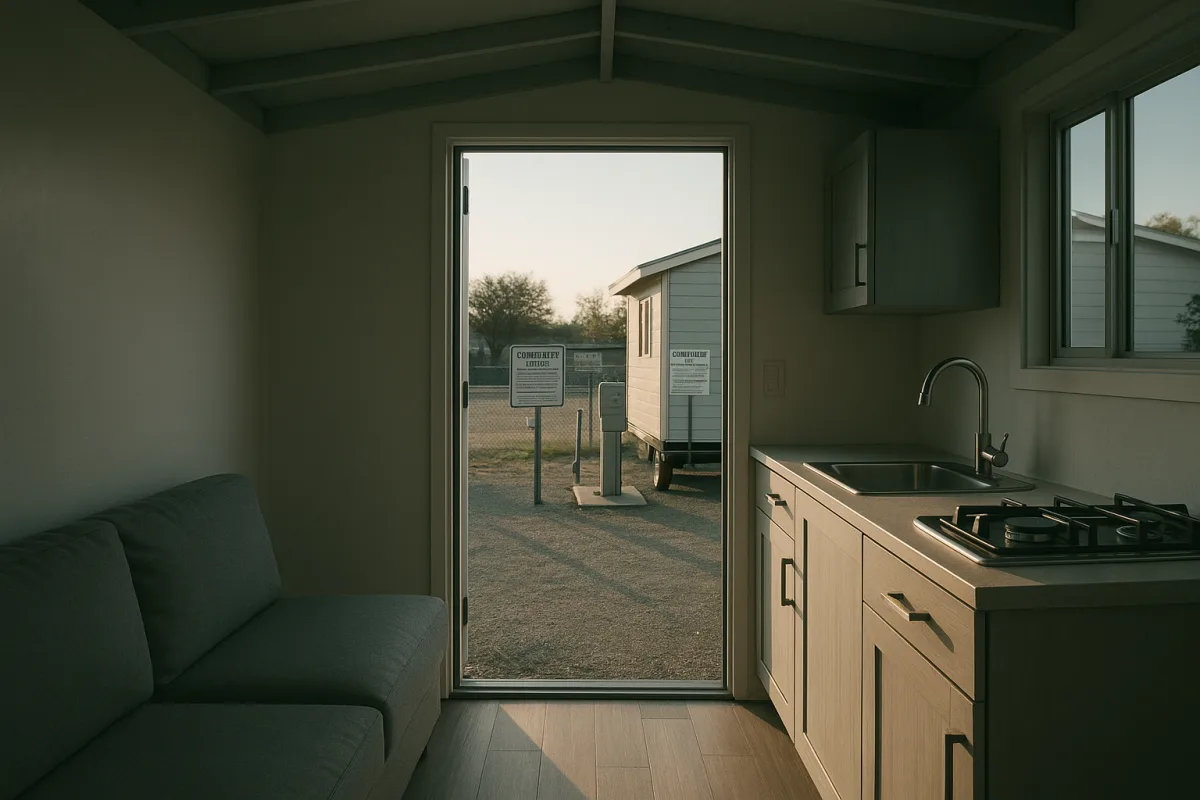
A purpose-built tiny-home community has already solved the expensive and politically difficult part of the project: land-use approval, roads, electrical service, water access, and wastewater handling. You rent a pad and connect your own home.
That is a very different proposition from buying raw acreage and assuming a trailer can stay there. A community operator has an incentive to know what their zoning approval allows, although you still need the terms in writing.
Tiny House Talk advises asking about your precise unit, not merely whether a place calls itself “tiny-house friendly.” Ask whether it accepts tiny houses on wheels, park models, travel trailers, or only one of those categories.
Also ask whether the lease permits full-time occupancy. Some RV parks allow a long stay, but retain seasonal limits or rules that make them unsuitable as your legal permanent address.
Molly McNown, co-owner of Namaste Hideaway in North Texas, learned the hard version of this lesson before opening a community with her husband Chuck. She first parked her 304-square-foot tiny house, Frieda Freedom, behind someone’s home.
The city told her to move it within two weeks or face a $2,000-per-day penalty, McNown told Tiny Home Tours. She relocated into a seven-lot tiny-house community within 24 to 48 hours after completing its screening process.
Her story shows why a community can be worth paying for even when you want independence. You are buying a place with infrastructure and an established operating model, not only a patch of gravel.
Namaste Hideaway opened about six months after McNown and her husband acquired land, following a longer planning period. They had to learn septic, electric service, and county-specific requirements as they went, because each jurisdiction worked differently.
That local variation remains the rule. There is no national tiny-house land law, and county lines can bring a new minimum-home-size requirement, a new RV occupancy rule, or a different view of what counts as a dwelling. [4][5]
What the monthly number really includes
Lot rent is the number you will see first, and it can look refreshingly low next to a conventional apartment. Current tiny-house pad rents range widely, from roughly $300 to $1,500 per month nationally. [2]
Lower-cost rural Midwest and Southern sites can fall around $100 to $250 monthly, while high-demand markets in California, Oregon, Colorado, and Florida can reach $900 to $1,500. [2] Availability, not square footage, often drives the price.
Named community examples show the middle of the market rather than a universal benchmark. Acony Bell Tiny Home Community in Mills River, North Carolina, lists $700 to $750 monthly, Circle Pond Tiny Community in Ruskin, Florida, starts at $625, and Tiny Town Orlando lists $650 to $850. [2]
Those quoted rents cover the pad, not necessarily the full cost of living there. Before signing, ask what is included, how each utility is metered, whether internet is mandatory, and whether there are application, pet, storage, or late-payment fees.
Electricity can run $60 to $180 monthly, depending on climate, insulation, home size, and heating equipment. Water and sewer can add $30 to $80 on municipal systems, while internet commonly costs $30 to $120. [7]
If your home uses propane, budget $20 to $80 monthly on average, with refills reported at $80 to $300 each, two to four times a year. [7] A tiny home uses less energy than a large house, but electric resistance heat can erase much of that advantage.
Tiny House Talk’s Birches Creek Village illustrates what a developed pad can provide. The East Texas community has 16 RV sites and nine sites for tiny houses on wheels and cottages, with full septic, water, and 50-, 30-, and 20-amp electric hookups.
Fiber internet is available at every site without a contract, according to Tiny House Talk. The village also requires applications and background checks, and pet approval, which are routine terms to factor into a move.
A site with utility connections is usually the better bet for a first-time buyer. We would choose one with individually stated charges over a vague “utilities available” promise, because you can budget it and compare leases honestly.
Buying land means buying the infrastructure problem
Private land offers more control and potentially lower monthly costs. It also transfers responsibility for every failed assumption, from whether a driveway can handle delivery to whether the soil will pass a septic evaluation.
Start with the parcel, not the seller’s description or mailing address. Tiny House Talk recommends using a county parcel viewer or GIS map to identify the property’s actual jurisdiction, zoning district, ownership, and city-limit status.
A mailing address can suggest a city while the lot is actually governed by the county. That difference can change your answer, particularly where a city allows ADUs but an unincorporated area has stricter rules for RV occupancy.
Read the zoning code’s definitions before reading listings. Search for “dwelling,” “recreational vehicle,” “accessory dwelling unit,” “manufactured home,” and “campground,” then find the permitted-use table for that zoning district.
A definition requiring a dwelling to sit on a permanent foundation is a warning sign for a tiny house on wheels. Many jurisdictions permit RVs only temporarily, even on land you own, and impose minimum dwelling sizes of 600 to more than 1,200 square feet. [4][5]
Then check dimensional requirements: minimum lot size, front and side setbacks, driveway access, maximum height, and utility rules. A small building does not exempt you from a large setback, and setbacks can leave no buildable area on a narrow parcel.
Private covenants are a separate layer. Even where zoning permits your plan, an HOA or deed restriction can forbid RVs, trailers, short-term rentals, or detached structures, and the stricter rule generally governs unless state law overrides it.
Illinois is a clear example of why state-level headlines cannot settle your decision. Tiny homes may be legal there, but local zoning and financing terms vary heavily among counties and municipalities. [6]
We would not buy rural land based on a phone call saying, “You should be fine.” Ask the planning department for the relevant code section, whether full-time occupancy is allowed, and which permits apply to your exact unit.
The backyard ADU route can be cheaper, but it is not casual
If a parent, friend, or partner already owns a home with a suitable backyard, an ADU can offer a more stable route than a campground. The unit is treated as housing connected to an existing residential lot.
Many cities permit ADUs with rules on unit size, parking, utility connections, and owner occupancy. Some states, including California and Vermont, require local governments to allow certain ADUs, though local standards still shape the project. [5]
An ADU often needs a permanent foundation and building permits, so it may not work for a travel trailer or every wheeled tiny house. The upside is a clearer housing classification and potentially stronger financing options.
A homeowner using a property for an ADU may be able to use home equity financing. Home-equity loans and HELOCs generally require existing equity, while a foundation-based tiny home on owned land may qualify for conventional mortgage financing. [3]
A wheeled home usually follows another path. RV loans for qualifying certified tiny houses commonly require 10 to 20 percent down and have reported interest rates of 6.5 to 11 percent, while personal loans can cost more and run for shorter terms. [3]
Think about the exit before you finance. Tiny houses on wheels commonly depreciate 10 to 20 percent in their first year and 40 to 60 percent over five years, broadly following RV-like resale patterns. [8]
A foundation-based home on owned land has a different value story because land can appreciate and traditional buyers can finance the purchase. That does not guarantee a profit, but it is a different asset from a towable home on rented land. [8]
Off-grid land is not a way around land-use rules
Off-grid systems can make a remote parcel livable where utility extension is too expensive. They do not erase zoning, sanitation, access, or occupancy requirements, and they can add a large upfront bill before your home even arrives.
Reported costs for a 4- to 8-kWh solar-and-battery system run $8,000 to $18,000. A well can cost $4,500 to $10,000, a cistern $1,500 to $4,000, and a septic system $6,000 to $12,000. [9]
A composting toilet costs about $1,500, but it does not necessarily remove the need for an approved wastewater plan. Local health departments may still regulate graywater, sinks, showers, laundry, and how waste is handled. [9]
For most buyers, a leased community pad is the lower-risk entry point because the big systems are already in place. If you want land ownership, treat the zoning confirmation and utility plan as conditions of purchase, not chores to handle after closing.
Frequently Asked Questions
What legal classifications affect where I can place a tiny house?
Tiny houses may be classified as recreational vehicles (RVs), accessory dwelling units (ADUs), park models, or permanent dwellings. Each classification carries different rules about full-time occupancy, hookups, setbacks, permits, and financing. This classification determines whether a tiny house can be legally placed on certain land or must be treated as storage or temporary parking.
How do tiny house communities handle land use and utilities?
Tiny house communities have already secured land-use approvals and installed infrastructure such as roads, electrical service, water, and wastewater systems. Residents rent a pad and connect their tiny home to these utilities. Each community sets its own rules about which types of tiny houses are allowed and whether full-time residency is permitted.
What are the typical monthly costs of renting a tiny house pad?
Monthly lot rents vary widely, from about $100 to $1,500 depending on location. Rural areas in the Midwest and South tend to be less expensive ($100-$250), while high-demand states like California, Oregon, Colorado, and Florida range from $900 to $1,500. These rents usually cover the pad only; utilities like electricity, water, internet, and propane are often additional costs.
Can I live full-time in a tiny house on wheels legally?
Living full-time in a tiny house on wheels depends on local zoning and occupancy rules. Even if a tiny house on wheels is certified as an RV or park model, local governments may restrict or prohibit permanent residency. It is important to confirm with the community and local authorities whether full-time occupancy is allowed.
What should I check before buying land for a tiny house?
Before purchasing land, verify how your tiny house is legally classified and whether local zoning permits that use. Contact the local planning department to get written confirmation that your tiny house type can be placed and occupied full-time on the land. This step helps avoid costly mistakes and legal issues.
How we researched this
This article was assembled from 1 video source, 4 published articles, 9 cited references.
Nothing here is based on hands-on testing. Where a figure or finding appears, it belongs to the source cited beside it, and the writing says so rather than implying otherwise. Every source is listed below so you can check it.
Sources
Turning a Tiny Living Dream Into Community, Tiny Home Tours
How Do I Get Land for a Tiny House or Camper? 5 Paths That Work, Tiny House Talk
Dezeen's favourite furniture and homeware from October, Dezeen
Birches Creek Village: A Quiet RV and Tiny Home Community in the East Texas Woods, Tiny House Talk
How to Research Tiny House Zoning in One Afternoon, Tiny House Talk
Scoop: Parker administration cancels planned tiny house village
Tiny House Communities: Lot Rent, Availability & Rules | Tiny House Fanatics
Can You Get a Mortgage on a Tiny House? (Financing Options 2026)
Tiny House Zoning Laws: Where Tiny Homes Are Legal | Zonloty
Land for a Tiny House: Where Tiny Homes Are Actually Legal (2026 Guide)
Are Tiny Homes Legal in Illinois? Zoning and County Rules - LegalClarity
Do Tiny Houses Hold Their Value? Resale Reality in 2025-2026
Watch Tiny House Communities and Legal Land Use Options on Youtube
Related Articles
Legal Tiny Homes on Land: Affordable Living with Permits
Explore legal tiny homes on land, covering permits, zoning, affordability, and land access for sustainable small-space living.
Downsizing to Tiny Homes in Communities
Explore downsizing to tiny homes in communities, covering costs, challenges, storage, and lifestyle changes for small-space living.
Prefab A-Frame Tiny Home Kits
Explore prefab A-frame tiny home kits, their design limits, costs, zoning tips, and assembly insights for small-space living.
Tiny Home Financing and Placement Costs Explained
Learn about tiny home financing options and the true costs of placing a tiny home, including zoning, delivery, and site preparation fees.