Downsizing to Tiny Homes in Communities
Explore downsizing to tiny homes in communities, covering costs, challenges, storage, and lifestyle changes for small-space living.
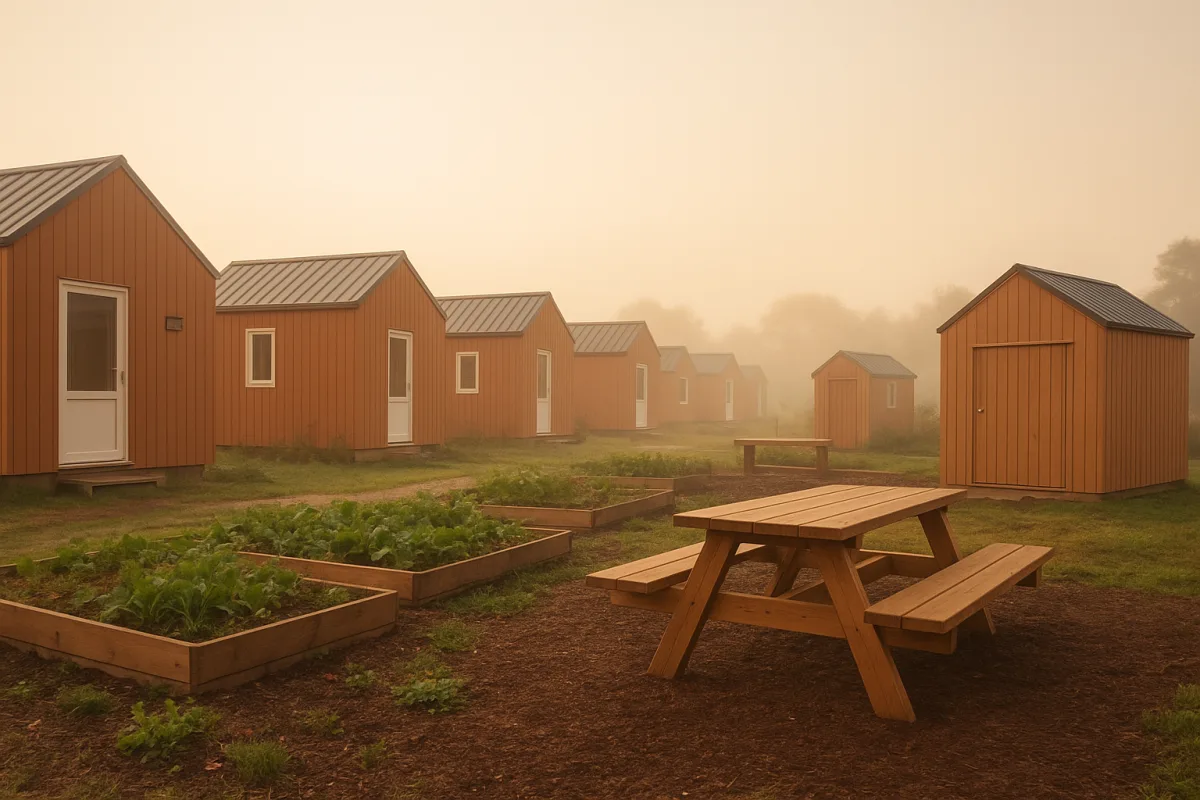
The shift is from tiny houses as isolated projects to tiny houses as community housing
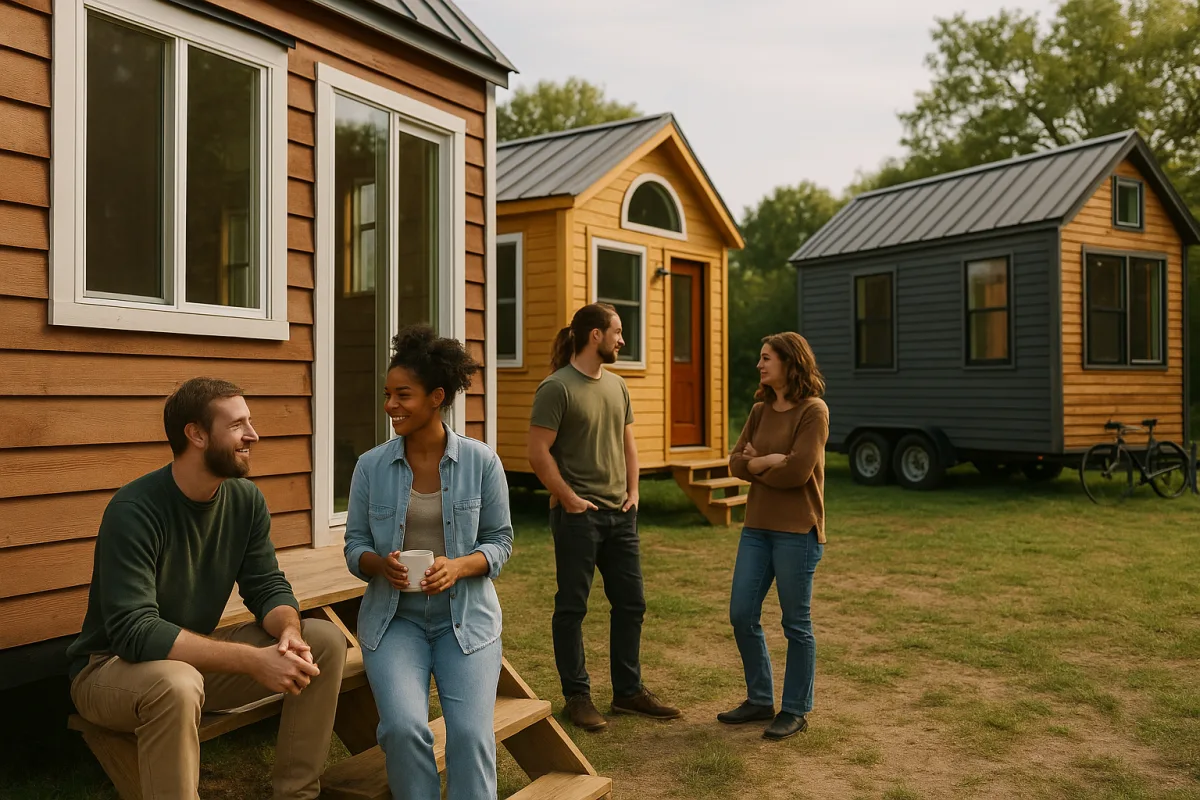
Tiny-house living is increasingly being sold, built and chosen as a community arrangement rather than a lone cabin on cheap rural land. The common formula is a compact privately owned home, a leased or shared site, and amenities that replace some of the space homeowners give up.
That is a real shift, not merely a social-media theme. A Tiny House Giant Journey tour of a Texas couple’s 399-square-foot home, Tiny House Talk’s reporting on Woodfield in Arizona, and reporting on a 170-person Tennessee community all point toward the same trade: less private square footage, more shared infrastructure and social access. [4][8]
The appeal is understandable. A large suburban home can become expensive, maintenance-heavy and oddly empty after children leave, while a well-run community can put recreation, landscaping, outdoor gathering space and neighbours within a short walk.
Still, the evidence is stronger on aspiration and individual stories than on a nationwide count of new tiny-house communities. There is no uniform national permitting system or accepted definition of a tiny home, so measuring growth cleanly remains difficult. [3]
Downsizing works best when the outside space does some of the work
The practical lesson from the Tiny House Giant Journey tour is not that 399 square feet suits everyone. It is that the residents made the smaller footprint workable by treating their porch, community amenities and surrounding grounds as extensions of the home.
The Texas homeowner featured by Tiny House Giant Journey moved from a 2,500-square-foot, five-bedroom suburban house into a 399-square-foot home. She describes the transition as difficult at first, despite ultimately valuing the lower cleaning burden and quieter daily routine.
Her community, The Oaks in East Texas, charges $699 in monthly lot rent, including water, sewer, yard care and access to amenities such as a pool, gym and pickleball facilities. The house itself cost $130,000 when purchased, according to the resident.
That $130,000 is not a complete cost of housing, and the $699 monthly charge should not be treated as a fixed universal benchmark. The tour does not establish delivery costs, insurance, financing terms, future rent increases, local taxes or what happens when the homeowner sells.
What does come through clearly is the lifestyle change. The residents spend mornings on the porch, use shared recreation, and accept that some activities must happen in sequence rather than in separate rooms at the same time.
That trade can be particularly attractive to people who have recently become empty nesters, retirees or remote workers with flexible routines. It can be much tougher for families with teenagers, people with substantial hobbies, shift workers, or anyone needing consistent private space.
The house still needs to do ordinary life, not just look tidy on a tour
Small homes reward deliberate storage, but built-in storage is not a magic solution. In the Texas home shown by Tiny House Giant Journey, a folding workstation, storage coffee table, wall shelves and sliding closet doors make everyday items accessible without taking over the floor.
The kitchen has a dishwasher, full-size refrigerator and a compact pantry, which matters more than fashionable finishes for residents who cook regularly. The owner openly says she would not recommend skipping the dishwasher, a useful counterweight to minimalist tiny-home imagery.
The compromises are equally plain. The washer-dryer combination also serves as the household hamper, closet volume is limited, and the loft suits the five-foot-two resident better than it would a taller adult needing to stand and work comfortably.
The loft became more useful than originally planned when the homeowner’s mother needed a place to stay after a stroke. That is a sensible example of flexible space, but it should not be mistaken for evidence that lofts provide accessible or long-term guest accommodation.
A community can ease the pressure of a small floor plan, but it cannot create more indoor privacy. Buyers should map their actual routines, including laundry, work calls, medical needs, pet supplies, winter indoor time and the amount of quiet each person needs.
Park model communities make the land question more explicit
Woodfield, a 55-plus park model community in Show Low, Arizona, offers another version of the trend. Residents own a park model home but lease the site, while the community supplies managed roads, shared spaces and several utility services. [4]
Tiny House Talk reports that Woodfield has operated since 2016 and offers one-bedroom and two-bedroom layouts of roughly 400 to 750 square feet. The community is positioned both for year-round residents and Phoenix-area owners seeking cooler seasonal stays. [4]
At Woodfield, the lease includes water, internet, sewer, trash and maintenance of roads and shared areas. The 2026 seasonal lease is $4,800 annually, while a year-round lease is $6,800, according to the available community information. [4]
Those figures work out to roughly $400 a month for a seasonal lease and about $567 a month for a year-round lease, before the home payment, insurance, personal property tax and any costs not listed by the operator. The available research does not establish extra utility or insurance costs.
Woodfield’s new homes, resales and custom additions may appeal to buyers who want a defined setting rather than raw land. However, no specific 2026 home prices were supplied in Tiny House Talk’s report, so there is no sound basis for comparing its purchase prices with the $130,000 Texas home.
The lease structure is not a minor detail. It means a buyer can own the dwelling while remaining dependent on the community’s rules, fee schedule and long-term operation, much as an RV-park resident or manufactured-home owner may be.
Community is an amenity, but it is also a commitment
The strongest personal case for these communities is not square footage. It is the chance to live near people, activities and shared outdoor spaces without maintaining all of them individually.
Prism News reported on a 170-person tiny-home community near Knoxville, Tennessee, where a retiree bought a Hobbit-style tiny home for about $25,000, plus finishing and site costs. The reported lot rent was approximately $200 monthly. [8]
That is substantially below the Texas and Arizona examples, but it does not make the Tennessee arrangement automatically cheaper overall. House condition, finishing work, local wages, utilities, insurance, lease terms and the resident’s needs can easily change the calculation.
The same reporting describes shared meals, neighbour support and organized activities, with many residents being single women aged 45 and older. [8] That suggests community living may be serving a social need that ordinary suburban housing often leaves unmet.
Intentional communities are also expanding beyond the familiar tiny-home park model. Heartwood Cohousing in Colorado planned 14 additional homes for fall 2026, with shared facilities including a common house, workshops, green space and sports courts. [10]
Community farming research similarly finds that shared growing and collective facilities can support everyday social routines, not just food production. [1] For a downsizer, that can mean exchanging an oversized private yard for useful shared places and more regular contact with neighbours.
But community is not a product feature that suits everyone. The supplied research did not find reliable comparative evidence on noise, privacy disputes or interpersonal conflict in tiny-house communities, so buyers should not assume a friendly tour atmosphere predicts daily reality.
Why this is happening now
Housing affordability is plainly part of the story. North America accounts for 54 percent of a global tiny-home market projected to reach $23.71 billion in 2026, although market forecasts should be treated as directional commercial research rather than a guarantee of local demand. [6]
For many buyers, the attraction is not absolute cheapness but a more manageable total commitment. A smaller mortgage or cash purchase can free money for travel, retirement, part-time work, recreation or simply lower monthly stress.
The Texas resident profiled by Tiny House Giant Journey says she still has a mortgage, but a smaller one after making a substantial down payment. That is a more realistic framing than claims that tiny homes eliminate debt altogether.
Remote work also changes what people need from a home. The Texas homeowner turned a loft into a workspace and added a separate air-conditioning unit because she spends much of the day there, showing that a home office remains a real space and energy requirement.
Climate and geography matter too. Woodfield’s appeal rests partly on the contrast between Phoenix heat and Show Low’s high-elevation pine setting, making a park model useful as a seasonal retreat as well as a primary home. [4]
The hard part is usually legality and financing
A community site does not erase the legal questions around tiny homes. Local governments may classify the same structure as an RV, park model, accessory dwelling unit or permanent residence, and each classification can bring different code, utility and occupancy rules. [3]
Suburban jurisdictions often limit tiny homes to accessory dwelling units, meaning they cannot function as independent primary homes on many lots. Municipal utility connections may also be required, which complicates plans for fully off-grid living. [3]
Rural land can offer more flexibility, but it is not a regulatory blank slate. Minimum acreage, septic approval, environmental review and tightening off-grid rules can all add cost and delay before a home can legally be occupied. [3]
HOA restrictions can be another barrier even where zoning permits the structure. Tiny Homes Nationwide notes that deed restrictions commonly prohibit tiny or manufactured homes, leaving buyers with a legal house type but nowhere they are allowed to place it. [2]
Financing follows the same classification problem. Traditional loans commonly require permanent foundations, code compliance, real-property title and, in many cases, at least 400 square feet, putting many sub-400-square-foot homes and homes on wheels outside ordinary mortgage products.
Freddie Mac’s average 30-year fixed mortgage rate was 7.28 percent in October 2026, but there is no reliable documented average interest rate for loans on tiny homes under 400 square feet. Buyers should expect limited options rather than assume conventional mortgage pricing.
Plan for an exit before signing a purchase agreement
A park model on wheels is generally personal property, not real estate, and that distinction can hurt resale prospects. Available resale research estimates park models retain roughly 55 to 70 percent of value after five years and 35 to 55 percent after ten. [7]
Homes built to HUD standards on permanent foundations can hold value better, particularly when sold with land. One resale guide estimates 70 to 95 percent value retention after five years for those homes, with location and local demand still doing much of the work. [5]
Woodfield gives owners a State of Arizona title to their park model rather than real-estate ownership of the underlying site. [4] That can reduce property-tax exposure, but it also means the buyer should understand the resale process and whether a future purchaser can assume or secure a lease.
Before committing, request the current lease, community rules, pet limits, guest policy, age restrictions, renewal terms, late fees and resale approval requirements. Ask whether the community has a waiting list, how many homes sold recently, and how long those homes took to sell.
The quiet benefit of downsizing is often not the house itself. It is the chance to spend less time maintaining rooms and belongings that no longer serve you, provided the community, legal structure and recurring costs fit the life you actually want.
Frequently Asked Questions
What are the challenges of downsizing to a tiny home in a community?
Downsizing to a tiny home, especially under 400 square feet, requires a serious reduction in possessions and a deliberate plan to manage storage so clutter does not return. Residents must adjust to less private indoor space and rely more on outdoor and shared community areas. The lifestyle change can be difficult initially and may not suit families or those needing consistent private space.
How do tiny house communities handle lot rent and shared amenities?
Tiny house communities typically lease the land or lot separately from the home, with monthly or annual fees covering utilities, maintenance, and shared amenities like pools, gyms, or roads. For example, a Texas community charges $699 per month including water, sewer, yard care, and access to amenities, while a 55+ park model community in Arizona charges $4,800 annually for seasonal leases or $6,800 for year-round leases covering water, internet, sewer, trash, and maintenance.
What should I consider when downsizing to a tiny home under 400 sq ft?
You should plan for significant lifestyle adjustments, including minimizing belongings and using outdoor or community spaces as extensions of your living area. Financing can be difficult since many tiny homes under 400 sq ft or on wheels do not qualify for conventional mortgages. It is also important to check the home's legal classification (real property, personal property, or RV) as this affects financing, zoning, taxes, and resale value.
How does community living affect privacy and storage in tiny homes?
Community living often means less private indoor space and requires sharing outdoor and communal areas. While shared amenities can compensate for limited indoor space, they do not increase indoor privacy. Storage must be carefully managed with built-in solutions and disciplined organization, as space is limited and lofts or flexible areas may not suit all needs.
What are typical costs involved in tiny home community living?
Costs include the purchase price of the tiny home plus ongoing lot rent or land lease fees, which often cover utilities and maintenance of shared spaces. For example, a 399-square-foot home might cost around $130,000, with monthly lot rent around $699 in some communities. In park model communities, annual leases range from $4,800 to $6,800, including water, internet, sewer, trash, and maintenance. Additional costs like insurance, financing, taxes, and future rent increases vary and should be researched.
How we researched this
This article was assembled from 1 video source, 1 published article, 10 cited references.
Nothing here is based on hands-on testing. Where a figure or finding appears, it belongs to the source cited beside it, and the writing says so rather than implying otherwise. Every source is listed below so you can check it.
Sources
We Downsized to a Beautiful Tiny Home in a Tiny House Community — Tiny House Giant Journey
Woodfield: A 55+ Park Model Community in the Pines of Show Low, Arizona — Tiny House Talk
Zoning Laws for Tiny Homes: ADUs, Permits, and Penalties - LegalClarity
Woodfield: A 55+ Park Model Community in the Pines of Show Low, Arizona – Tiny House Talk
Retiree's $25,000 Hobbit tiny home joins 170-person community | Prism News
Watch Tiny House Community Living and Downsizing Stories on Youtube
Related Articles
Tiny House Living Stories
Explore tiny house living stories and downsizing experiences with real cost, layout, and lifestyle insights from long-term tiny home residents.
Tiny House Communities: Costs, Dynamics, and Benefits
Explore tiny house communities, their costs, governance, and social impact. Understand what living in a tiny house community entails.
Community Living in Tiny Homes: A Growing Trend
Explore community living in tiny homes, its benefits, challenges, and why it's becoming a popular alternative lifestyle.
Prefab A-Frame Tiny Home Kits
Explore prefab A-frame tiny home kits, their design limits, costs, zoning tips, and assembly insights for small-space living.