Tiny House Financial Freedom: Downsizing Success Stories
Explore tiny house financial freedom with real downsizing success stories, costs, and financing tips to help you plan your small-space living journey.
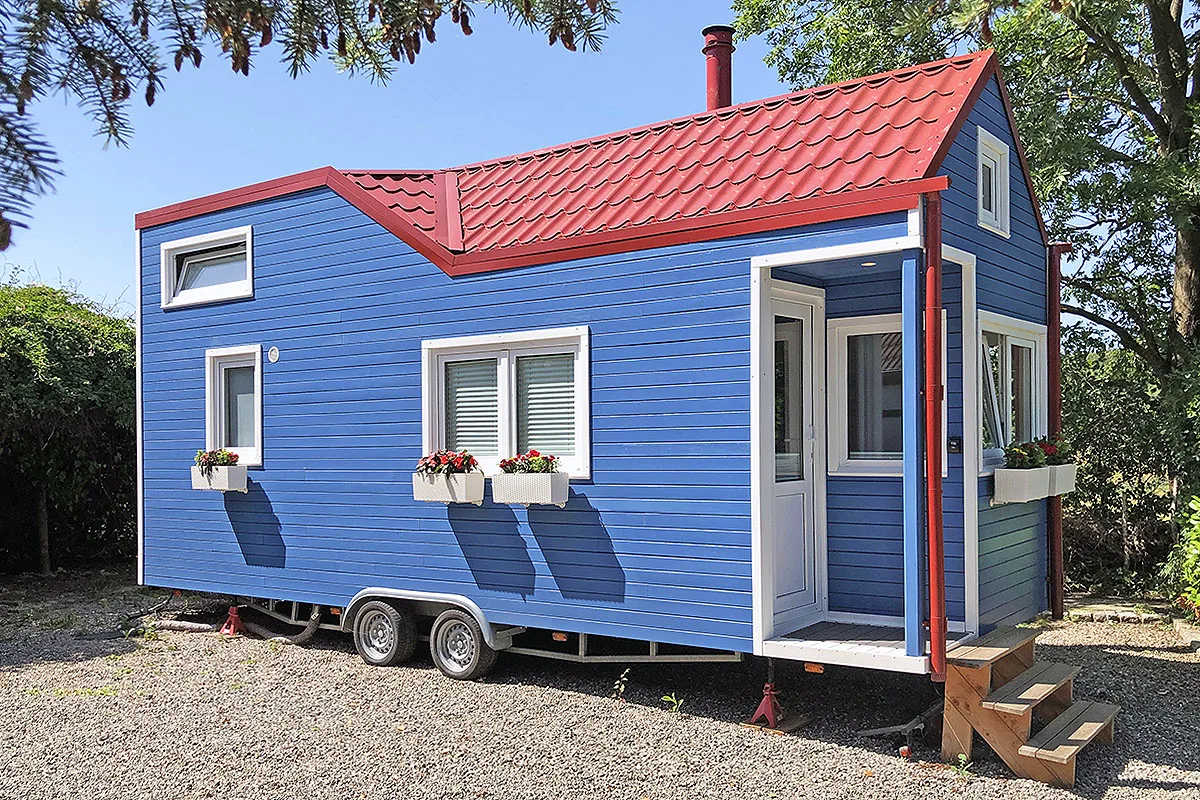
Photo: Küste, CC BY-SA 4.0, via Wikimedia Commons
A $200,000 backyard move, instead of a $400,000 addition
In Hailey, Idaho, homeowner Christie moved from her two-bedroom, two-bath main house into a 34-foot-long tiny home, then rented the larger house to a family. Tiny House Giant Journey featured the arrangement after she had lived in the smaller home for three years.
Christie paid about $150,000 for the 11.5-foot-wide house, plus roughly $8,000 for delivery, setup, and skirting. Water, sewer, electrical hookup, and an electrical upgrade to support the additional home cost another approximately $50,000.
Her all-in figure was about $200,000. Christie told Tiny House Giant Journey that expanding the garage and adding a conventional accessory dwelling unit would have cost an estimated $300,000 to $400,000, so the trailer-based home was the lower-cost way to create two functioning residences.
That story gets at a real shift in tiny living. For established homeowners, the tiny house is increasingly not a first home replacing rent, but a way to release an oversized primary house for tenants or family while keeping access to an owned property.
The evidence is still thin on how common that arrangement has become nationally. No comprehensive 2026 data tracks tiny-house buyers’ motivations, long-term financial outcomes, or default rates, so individual stories cannot show how often this plan succeeds.
Christie’s layout also explains why her setup works for one person. Her home has a main-floor living area, full-size appliances, a full-size refrigerator, under-stair storage, and a loft used for guests and seasonal storage, with outdoor space doing part of the entertaining work.
We would pick this general format for a homeowner with land, stable local rules, and a desire to keep a larger house in service. We would skip it for anyone assuming a tiny house can be dropped into any backyard, because zoning, setbacks, utility requirements, and minimum dwelling-size rules are highly local. [6][7][8]
Housing costs are pushing people toward smaller fixed payments
A tiny-house consultant featured by Tiny Home Tours said housing had reached 56% of her take-home pay before she bought her 26-foot-long, 8.5-foot-wide house on wheels. More than five years later, she describes the home as the change that made her work and lifestyle sustainable.
Her route was not about owning land or renting out a larger property. She was moving states to support her sister through health problems, so the ability to relocate the house had financial value alongside the smaller living space.
Her experience shows where tiny homes can help most: when the expensive part of your life is monthly housing, not when you are merely trying to buy the smallest structure possible. Lower square footage can reduce furnishings, utilities, insurance, and maintenance, but it does not erase site costs.
Tiny homes nationwide estimates typical tiny-home utilities at $140 to $380 per month in 2026, while insurance commonly runs $500 to $1,500 annually. Those are averages, not guarantees, and electricity use, climate, insulation, and whether your lot includes utilities can move the number sharply. [9][11]
Lot rent is the recurring bill many early budgets miss. Tiny-home park estimates commonly fall around $300 to $800 per month, before electricity and any separate internet, although high-demand locations can run higher. [12]
The homeowner featured by Tiny Home Tours paid $800 monthly lot rent, with everything except electricity included. Her case shows why “mortgage-free” does not mean housing-cost-free, even after the structure itself is paid off.
A Florida Keys listing illustrates the same trade-off at a higher location premium. Tiny House Talk reported on November 18, 2026, that a 1998 RV-style one-bedroom at Galway Bay in Marathon was listed at $62,900, with annual-paid lot rent of $929 per month.
The unit comes with a screened porch, deck, shed, and access to a 55-plus boating community. It may be a low-cost entry to the Keys compared with a conventional house, but you are buying the unit, not the land, and the monthly site payment remains.
Paying off a tiny house early can solve one problem and create another
The Colorado homeowner featured by Tiny Home Tours bought a fully electric tiny home for $122,000, then discovered the sticker price was only the opening number. She also paid close to $6,000 in titling and sales tax, about $5,000 to furnish it, and roughly $18,000 for required landscaping and skirting.
That puts her reported outlay near $151,000 before counting her ongoing $800 lot rent and electricity. The landscaping requirement was a surprise, and her advice is the right one: get every community requirement and its cost in writing before committing.
She financed the house, then found that early loan payments were overwhelmingly going toward interest. Wanting to remove the monthly payment, she withdrew retirement money and paid off the home early, trading future retirement funds for present-day cash-flow security.
That decision may fit someone with substantial retirement savings, no high-interest debt, and a strong reason to reduce fixed expenses. We would not treat early payoff as automatic financial freedom, because drawing retirement funds can have tax consequences and removes money from long-term investment growth.
Financing is a major dividing line between a tiny house on wheels and a small house on a foundation. A trailer-based home is usually personal property, not real estate, which often puts conventional mortgages out of reach. [3][4]
Personal loans, chattel loans, RV loans, and builder financing fill that gap, but reported 2026 ranges are commonly 6% to 12% APR for personal loans and 7% to 14% for chattel loans. Typical down payments run 10% to 20%, depending on the lender and borrower. [4][5]
That explains why a buyer can be approved for a tiny-house loan yet still dislike its amortization. Lender valuation remains inconsistent because houses on wheels lack a standardized real-estate appraisal system, and terms vary materially by credit profile, lender, age of home, and certification. [3][5]
The cheapest success story has the most demanding conditions
Susie, a Florida self-builder featured by Tiny House Expedition, built her 8-by-16-foot home after losing everything in a 2011 flood. The channel identifies the build as a 38-day, $17,000 project, while Susie says her original budget was under $20,000.
She had no previous construction experience beyond making a few boxes. After nearly 12 years in the 128-square-foot home, she says only one year required cash rent because she has often exchanged work for rent and utilities at the horse ranch where she parks.
That is a striking housing-cost result, but it depends on skills, health, available work arrangements, and a landowner willing to host the home. It is not a budget template most buyers can reproduce.
Susie’s home also shows the physical trade-offs that rarely appear in a floor plan. After an elbow replacement and five further surgeries, she stopped sleeping in the loft because climbing stairs became unsafe with limited arm strength.
Her current arrangement has her sleeping on a six-foot couch, with the loft and attic used for storage. A small house can adapt, but stairs, grocery carrying, water jugs, toilet maintenance, and everyday reaching become major design questions when mobility changes.
DIY remains the lower-cost route, but it is not automatically cheap once tools, a trailer, materials, mistakes, inspections, and time are counted. Reported 2026 DIY tiny-house costs range from $20,000 to $80,000, while professionally built houses on wheels commonly average $85,000 to $110,000 for 20-to-28-foot units. [1][2]
Park models are widening the middle of the market
Dealer listings from late 2026 show another trend: buyers who want more room than a narrow tiny house on wheels can offer are looking at park models. These are RV-standard units, usually capped just under 400 square feet, built on a chassis and commonly placed in resorts or designated communities.
Tiny House Talk reported that Little Homes of Texas listed a 2025 Platinum Cottages Tumbleweed 576SL at $69,900 starting price on November 10, 2026. The 15-foot-wide, roughly 26-foot-long model has 399.45 square feet, a main-floor bedroom, optional loft, and porch.
The $69,900 figure is a base starting price, not a complete move-in cost. Delivery, setup, land, utilities, permits, and options such as the pictured loft and porch can raise it, and the dealer says delivery and setup may be folded into financing.
At the upper end, Tiny House Talk reported that Bob’s RV Sales in Hemet, California, listed a 2025 Cavco Alpine Loft D for $89,770 on November 10, 2026, down from a $105,599 MSRP. Its 399-square-foot plan includes a rear queen bedroom, laundry, loft, and window-wall living room.
For buyers prioritizing finish quality over low upfront price, Park Model Homes in Spokane Valley listed the furnished Kropf Eldorado 9051 at $163,850 on the same date. The 399-square-foot, non-loft model includes furniture, washer and dryer, dishwasher, and a main-floor queen bedroom.
These three listings show a broad price ladder, from about $70,000 to $164,000 before site expenses. They also show why “tiny” no longer reliably means inexpensive, particularly once buyers want full appliances, laundry, wide layouts, finished interiors, and four-season construction.
We would choose the wider park-model format for a couple, a remote worker, or someone who needs a main-floor bed and bath. We would choose a narrower house on wheels only when frequent relocation genuinely outweighs the compromises of towing, parking rules, and RV-style depreciation.
Houses on wheels commonly retain about 45% to 75% of value over five years, according to recent transaction-based estimates, behaving broadly like RVs. Small homes on permanent foundations with owned land can perform differently and may retain or gain value, but the outcome depends heavily on land and local market conditions. [1][13]
Build your budget around the site, not the showroom photo
A bright kitchen, large television, screened porch, or dramatic window wall can make a tiny home feel complete. The financial test comes later, when you price delivery permits, site preparation, utility trenching, foundation or tie-down requirements, insurance, taxes, furnishing, and the monthly place to park.
Start by asking the community or county whether your exact model is allowed, whether it can be your full-time residence, and which hookups are required. Then get written figures for every required improvement, including skirting, stairs, decks, landscaping, electrical upgrades, and storm tie-downs.
For most readers, we would do that work before putting down a deposit. The strongest downsizing stories here did not come from finding the smallest possible home, they came from matching a smaller structure to a specific financial pressure and a site that could support it.
Frequently Asked Questions
How can living in a tiny house lead to financial freedom?
Living in a tiny house can reduce monthly housing costs significantly, especially when downsizing cuts a specific existing expense like rent or maintenance on a larger home. For some, like the homeowner who moved into a tiny house on wheels, smaller living space lowered housing costs enough to make work and lifestyle sustainable. However, financial freedom depends on managing site costs and ongoing expenses, not just the cost of the structure.
What are the hidden costs of owning a tiny house?
Beyond the purchase price, tiny house owners often face substantial additional expenses such as delivery, utility hookups, skirting, landscaping, permits, and taxes, which can add tens of thousands of dollars. Lot rent is another recurring cost that many first-time tiny house buyers overlook, ranging typically from $300 to $800 per month. Other ongoing costs include utilities, insurance, and maintenance, which vary based on location and setup.
How do tiny house financing options affect long-term financial freedom?
Financing tiny houses on wheels is challenging because they are classified as personal property, limiting access to traditional mortgages. Buyers often rely on personal loans, chattel loans, or builder financing, which tend to have higher interest rates and shorter terms. Paying off a tiny house early can reduce monthly expenses but may require using retirement funds or other savings, which can trade future security for present cash flow.
What are typical monthly expenses for tiny house living?
Typical monthly utility costs for tiny houses range from $140 to $380, depending on factors like electricity use and climate. Insurance usually costs between $500 and $1,500 annually. If the tiny house is on rented land, lot rent is an additional expense, commonly between $300 and $800 per month. These ongoing costs mean that even without a mortgage, tiny house living still involves regular housing expenses.
How we researched this
This article was assembled from 4 video sources across 3 channels, 4 published articles, 13 cited references.
Nothing here is based on hands-on testing. Where a figure or finding appears, it belongs to the source cited beside it, and the writing says so rather than implying otherwise. Every source is listed below so you can check it.
Sources
No Mortgage, No Loan: Why She Paid Off Her Tiny Home Early, Tiny Home Tours
Housing Ate 56% of Her Paycheck. Her Tiny Home Fixed It, Tiny Home Tours
She outsmarted the housing crisis by transforming her property..., Tiny House Giant Journey
She Built Her Tiny House in 38 Days for $17k! (After Losing Everything), Tiny House Expedition
Tumbleweed 576SL by Platinum Cottages: A 15-Foot-Wide Park Model in Conroe, Texas, Tiny House Talk
Cavco Alpine Loft D: A Park Model With a Gable Window Wall and a Big Loft in Hemet, Tiny House Talk
Kropf Eldorado 9051: A Furnished Non-Loft Park Model With Tall Pine Ceilings, Tiny House Talk
A Turquoise Trailer With a Screened Porch in a Florida Keys Boating Community, Tiny House Talk
Tiny House On Wheels Cost in 2026: Real Numbers, Real Options
Do Banks Finance Tiny Homes on Wheels? | CERTAFI Field Notes
Tiny Home Financing, RV Loans, Personal Loans & Mortgage Options (2026)
Tiny Home Financing: How to Finance a Tiny House (2026 Guide) | ModFii
Can You Put a Tiny House on Your Property: Zoning Rules - LegalClarity
Do Tiny Homes Need Permits? Foundation, Wheels, and Zoning - LegalHelp
What States Are Tiny Houses Illegal In? State Laws and Local Rules Explained, Catalyst Legal
Monthly Cost of Living in a Tiny Home Park: Real-World Budget for 2026 | Tiny Home Sherpa
Watch Tiny House Financial Freedom and Downsizing Success Stories on Youtube
Also from the sources
Related Articles
Early Mortgage Payoff for Tiny Houses: Downsizing Insights
Explore early mortgage payoff for tiny houses, including costs, loan details, and downsizing tips for financial freedom in small-space living.
Tiny House Living for Retirement
Explore tiny house living for retirement, including costs, design tips, and how it supports financial freedom and downsizing.
Tiny House Living Stories
Explore tiny house living stories and downsizing experiences with real cost, layout, and lifestyle insights from long-term tiny home residents.
Building Tiny Homes on Foundations
Learn about building tiny homes on foundations, including costs for site work, permits, and utilities to plan your land-based tiny house budget.