Tiny House Costs After Divorce: What You Need to Know
Learn about tiny house costs after divorce, including financing, land, utilities, and downsizing tips for a smooth transition.
Tiny House Living After Divorce: The Real Cost of Starting Over Small
Reinvention is not the same thing as cheap housing
After a divorce, a smaller home can offer something more immediate than a dramatic lifestyle statement: a place that is manageable. The appeal is often less about living with almost nothing and more about reducing decisions, upkeep, commuting, and financial exposure.
That distinction comes through in two home tours. Both residents made their moves after divorce, but their tiny houses solved different problems. One wanted a settled home in a mountain community, while the other needed a practical weekday base near work.
Lorraine, featured by Tiny House Giant Journey in Blairmore, Alberta, moved from a house of more than 2,000 square feet into a 341-square-foot, 26-foot tiny house after separating following a 31-year marriage. Her daughters prompted her to take an old interest in tiny homes seriously.
The Wisconsin business owner featured by Tiny Home Tours had kept a lake house after his divorce, but it was about 50 miles and roughly an hour from work. He built a 28-foot tiny house on the property of his family business instead.
Neither story is really about a tiny house being inherently inexpensive. Each works because the resident matched a small dwelling to a specific life problem. That is the useful lesson for anyone considering tiny living after a major change.
The number to understand: your housing stack
The number worth unpacking is not the advertised build price. It is the housing stack, the combined cost of obtaining the house, placing it legally, connecting it, paying for land, and keeping it running month after month.
A conventional home purchase wraps many of those pieces into one recognizable transaction: mortgage, property tax, utilities, and maintenance. A tiny house on wheels splits them apart, often across a builder, lender, landowner, municipality, utility company, insurer, and homeowner.
Start with the house itself. Lorraine told Tiny House Giant Journey that her 26-foot home from Alberta builder Teacup Tiny Homes cost $160,000 all-in at the time she built it. The tour does not provide a detailed itemized quote.
That figure should not be treated as a current base price for a comparable 26-foot model. Teacup Tiny Homes currently lists fully built homes from $155,000 to $240,000 CAD, depending on weight, style, products, and trailer-related requirements. [1]
The company also advises buyers to budget at least $20,000 CAD for personalization and upgrades. [1] That matters because post-divorce buyers often need particular features, such as a workable office, guest sleeping, a bathtub, or more storage, rather than a stripped-down weekend cabin.
Broader North American price guides cite roughly $30,000 to $80,000 for a 22-to-28-foot prefab tiny house and $50,000 to $125,000 for a custom build. [2] Those figures are useful context, but they do not make a Canadian, cold-climate custom build interchangeable with a low-cost prefab unit.
The Wisconsin owner gave a clearer example of the next layer. He told Tiny Home Tours that his completed tiny house cost about $70,000, then required another roughly $10,000 for landscaping, a concrete pad, and bringing power and water to the site.
That $10,000 is not decorative spending. It is part of making a dwelling inhabitable. A house delivered to a field is not a home until it has safe access, weather-appropriate support, electricity, water, wastewater arrangements, and whatever permits local rules require.
Utility work is the wild card in many budgets. Canadian guidance cited in the research brief puts possible utility-connection costs at roughly $15,000 to $125,000, depending on existing infrastructure and the site. [9][11] A serviced lot and raw land are fundamentally different purchases.
Why the land decision determines the outcome
The Wisconsin homeowner’s setup was unusually favorable because he already had access to business property. He did not need to buy a separate parcel, and the home sat close enough to work that it replaced a long weekday commute.
That does not mean private land automatically solves the problem. The resident describes the tiny house as mobile and temporary, but whether a local authority agrees depends on local zoning, building rules, sanitation requirements, and the duration of occupancy.
Across Canada, tiny homes on wheels are commonly treated as trailers or RVs, while a foundation-based small home is treated more like a dwelling. That classification affects whether it can be occupied year-round, where it can be placed, and what inspections apply. [9][10][12]
In Alberta, tiny houses on wheels are generally classified as RVs, and permanent year-round habitation can be restricted unless the home is placed on a foundation and its wheels are removed or concealed. [6] That is a major issue for someone seeking a permanent post-divorce home.
Lorraine’s arrangement avoids the raw-land problem because she lives in a community of tiny homes and micro-cabins with town-connected water, sewer, and power. Her home still has wheels, but its placement comes with an established service arrangement.
Her reported monthly stack is $900 for the mortgage and $660 for the land fee, with power and water included. She pays propane separately, filling it more regularly during Alberta winters. That totals $1,560 monthly before propane, insurance, phone, food, or repairs.
The $660 land fee is not an incidental add-on. It is 42 percent of her stated $1,560 monthly housing payment before propane. Someone comparing only the house loan with rent could easily miss that nearly half of the monthly cost comes from location.
For Alberta residents leasing land, rough 2026 estimates put land fees at $400 to $900 CAD monthly, electricity at $30 to $80, water and sewer at $30 to $60, and propane at $20 to $80. Combined ongoing costs can land around $500 to $1,100 monthly. [7][16]
Those are planning ranges, not a quote for a particular park. Lorraine’s $660 fee includes power and water, which is why it cannot be compared directly with a bare land-rent figure. Ask exactly which utilities, snow removal, garbage, and maintenance are included.
Financing changes the meaning of “affordable”
A small house does not necessarily come with a small mortgage. Houses on wheels are usually personal property rather than real estate, so lenders may offer RV loans, chattel loans, builder financing, or unsecured personal loans instead of a standard mortgage. [3][4][5]
That affects both approval and cost. RV loans may require RVIA or CSA certification, 10 to 20 percent down, and terms of 10 to 20 years, while chattel loans for factory-built homes on leased land can run 15 to 25 years. [3][4]
The financing distinction is not paperwork for its own sake. Certification gives a lender and insurer some confidence about construction standards. A self-built or uncertified unit can be harder to finance, insure, and later sell, even if it appears well made. [3][4][15]
For a buyer rebuilding after divorce, the loan term is a trade-off. A longer loan may lower the monthly payment, which can help cash flow during a disruptive period. It may also leave the owner paying interest on an asset that behaves more like a vehicle than land-backed housing.
General resale guidance suggests that a $90,000 tiny house on wheels might resell for $45,000 to $55,000 after six to eight years, though actual value varies sharply by condition, certification, design, and local demand. [13][14] That is not guaranteed depreciation, but it is a sensible caution.
A foundation-built tiny home on owned land is different. It may qualify for conventional mortgage financing if it meets minimum size, code, and property requirements, and land can contribute to long-term value. [3][5] It also requires a larger initial commitment and less mobility.
What the two homes give up, and what they preserve
The physical designs in these stories are not generic tiny-house checklists. They show how residents chose which ordinary comforts mattered enough to spend space and money on.
Lorraine gave up some kitchen counter space for a wood stove, then paired it with a forced-air furnace. Her builder ran water pipes above the air-vent system in a protected wall assembly, a practical detail in a place where she reports temperatures reaching minus 40.
Her home is not off-grid. It uses full sewer, water, and power connections, plus propane and wood heat. That may sound less romantic than a self-sufficient cabin, but it is a sensible setup for a year-round home in an Alberta mountain community.
She also chose a full bathtub instead of a smaller shower. In 341 square feet, that choice means some other feature must shrink or disappear. It is a useful reminder that good downsizing is not about choosing the smallest possible fixtures.
The Wisconsin owner similarly prioritized daily routines. He wanted a gas range with oven, a large shower, a queen bed he could walk around, and a mini-split heat pump that he says held the home at 68 degrees during severe winter weather.
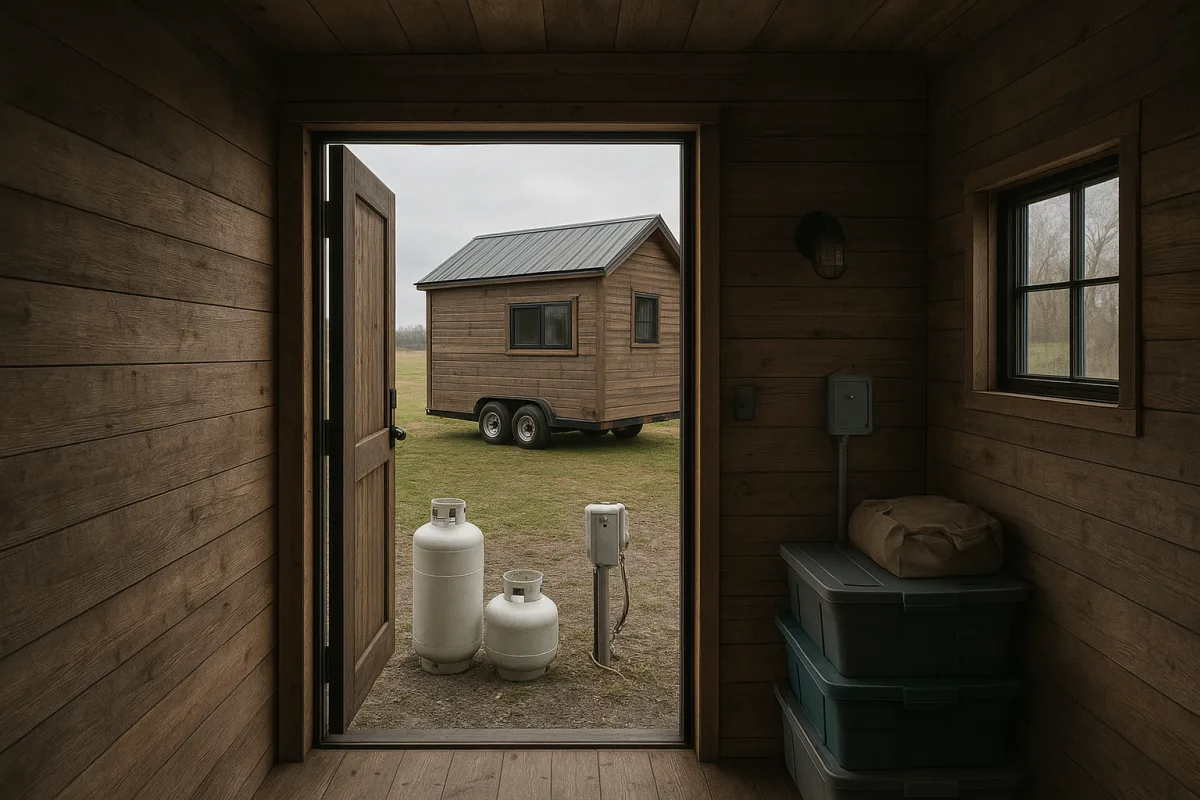
His two 30-pound propane cylinders serve cooking, and the tiny house connects to septic for a flush toilet. This is not a rugged, low-utility setup either. It is a compact conventional home with deliberately limited storage and a smaller physical footprint.
Both residents use storage as a behavior tool. Lorraine kept some belongings in Edmonton and has her daughters bring boxes during visits, allowing her to sort gradually. The Wisconsin homeowner relies on under-bed storage, a storage loft, baskets, and buying groceries more often in smaller quantities.
That staged approach is particularly relevant after divorce, when belongings can carry practical and emotional weight. There is no prize for discarding everything in one weekend. Renting storage temporarily can cost money, but it can prevent expensive replacement purchases or rushed regret.
A tiny home can support a new life, not erase the old one
Lorraine’s smaller home helped create room for another change. After moving to Blairmore, she opened Tuesday’s Bookshop in Fernie, turning an old ambition into a community gathering place. The tiny home was part of that reinvention, not its sole cause.
The Wisconsin owner’s house performs a quieter role. It lets him shower, cook, sleep, and begin work nearby, while keeping his lake home for another part of his life. Tiny living does not have to mean making one property carry every purpose.
The practical question is therefore not, “Can I fit into 300 square feet?” It is, “Which costs and responsibilities am I trying to reduce, and which ones am I still willing to carry?”
For some people, the answer will be a serviced tiny-home community like Lorraine’s. For others, it will be a legally permitted small dwelling on family land, as the Wisconsin owner arranged. The right choice depends more on placement and financing than floor plan alone.
Frequently Asked Questions
What are the total costs of living in a tiny house after divorce?
The total monthly costs, or housing stack, include loan payments, land fees, utilities, propane, insurance, and site costs. For example, monthly expenses on leased land in Alberta typically range from about $500 to $1,100 CAD, covering electricity, propane, water, sewer, and land lease fees. Initial build costs vary widely, from roughly $30,000 to over $160,000 CAD depending on size, customization, and location.
How does land ownership affect tiny house expenses post-divorce?
Land ownership significantly impacts overall expenses. Parking a tiny house on family or business property can eliminate land purchase costs but may still involve zoning, permitting, and utility connection challenges. Conversely, buying serviced land often adds substantial upfront costs and ongoing fees, including land lease payments that can range from $400 to $900 CAD per month.
Can I finance a tiny house on wheels after a divorce?
Financing a tiny house on wheels is possible but typically more complex than a conventional mortgage. These homes are often classified as RVs or personal property, requiring RV loans, chattel loans, personal loans, or builder financing, with interest rates generally higher and down payments larger than traditional home loans. Certification from RVIA or CSA is important for loan eligibility, and conventional mortgages usually apply only to foundation-built homes over 400 square feet on owned land.
What should I budget for utilities and land fees with a tiny house?
Monthly utility costs in Alberta for a tiny house generally include $30–$80 CAD for electricity, $20–$80 CAD for propane, and $30–$60 CAD for water and sewer. Land lease fees typically add $400–$900 CAD per month depending on location and land type. Overall, expect to budget approximately $500 to $1,100 CAD monthly for these ongoing expenses.
How to downsize gradually when moving into a tiny house after divorce?
Downsizing works best as a staged process rather than an immediate purge. Keeping overflow belongings in storage or another location while adjusting to the smaller space allows for a more manageable transition. This approach helps identify what fits and what is truly needed before fully committing to the tiny house lifestyle.
How we researched this
This article was assembled from 2 video sources across 2 channels, 16 cited references.
Nothing here is based on hands-on testing. Where a figure or finding appears, it belongs to the source cited beside it, and the writing says so rather than implying otherwise. Every source is listed below so you can check it.
Sources
Going Tiny After Divorce. Reinventing Myself & Loving It — Tiny House Giant Journey
He Chose a Tiny Home After His Divorce — Tiny Home Tours
Can You Get a Mortgage on a Tiny House? (Financing Options 2026)
Do Banks Finance Tiny Homes on Wheels? | CERTAFI Field Notes
Tiny Homes In Alberta: Everything You Need To Know - Tiny Life
Monthly Cost of Living in a Tiny Home Park: Real-World Budget for 2026 | Tiny Home Sherpa
Tiny Homes in Canada: Rules, Costs, and Where They're Actually Legal - Homeowner.ca
Tiny Home Bylaws Canada 2026: What Changed And What’s Legal - ADU Start
Tiny House Depreciation Value Over Time: What Tiny Homeowners Need to Know in 2026
Watch Tiny House Living After Major Life Changes on Youtube
Also from the sources
Related Articles
Tiny House Living After Major Life Changes: Planning & Costs
Explore tiny house living after major life changes with tips on budgeting, legal steps, and family-friendly design for a smooth transition.
Building Tiny Homes on Foundations
Learn about building tiny homes on foundations, including costs for site work, permits, and utilities to plan your land-based tiny house budget.
Prefab Tiny Home Kits Cost Breakdown and Features
Explore prefab tiny home kits cost breakdown under $100K, including features, installation, and financing challenges for buyers.
Tiny House Living Stories
Explore tiny house living stories and downsizing experiences with real cost, layout, and lifestyle insights from long-term tiny home residents.