Tiny House Community Types: Lot-Lease vs Land Ownership
Explore tiny house community types, including lot-lease and land ownership, amenities, privacy, and costs to find the right shared living option.
Start with the space outside your front door
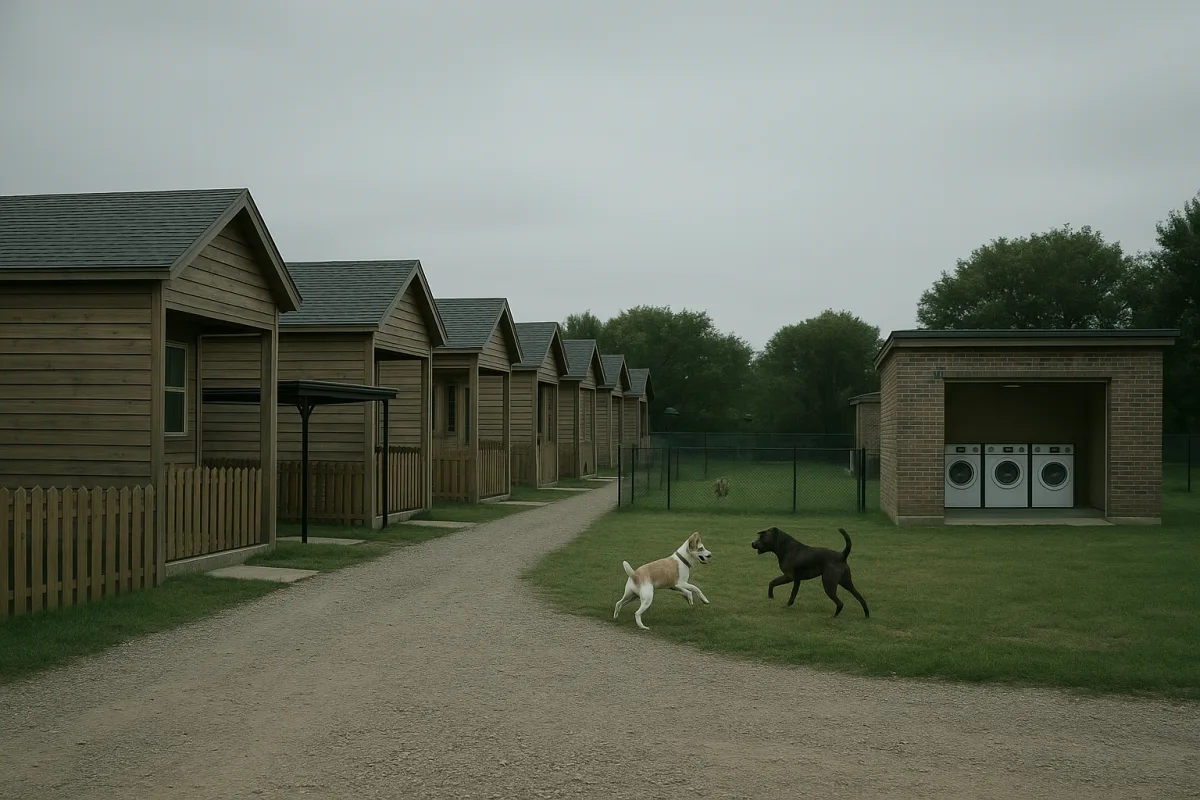
The dog park gate, the distance to the nearest laundry room, and the shade over your parking space are not small details. In a tiny-house community, these shared features become part of your everyday square footage.
Cozy Acre Tiny Home Community in Poolville, Texas, is one example of what a small, owner-run lot-lease setting can offer. The 16-lot community has shaded sites, a fenced dog park, picnic area, free indoor laundry, and full hookups for water, sewer, and trash. [2]
Electricity is metered separately at Cozy Acre, and residents arrange their own internet. That means the advertised convenience of a full-hookup site still requires a monthly budget for power and connectivity, especially if you work from home. [2]
We would put shade high on the list in North Texas. A mature tree canopy can make an outdoor sitting area usable and reduce solar heat hitting a small home, but inspect the actual lot for dead branches, drainage problems, and roots affecting a deck.
Ask where guests park before signing. Cozy Acre allows one vehicle per site and has additional on-site parking, but a visiting partner, adult child, caregiver, or contractor can quickly expose whether a community’s parking policy fits your life. [2]
Decide whether you need a rental lot or land ownership
A lot-lease community lets you bring or buy a tiny home while renting the pad beneath it. The lower entry cost can help, but you are still exposed to lease renewals, rule changes, rent increases, and the challenge of financing a home without land.
Cozy Acre requires a six- or 12-month lease, a background check, a security deposit, and the first month’s rent before arrival. Its published rules also say rent is due on the first of the month, with a $25-per-day late fee. [2]
Cozy Acre has not published fixed current lot rents. Call 817-729-5445 or email infocozyacre@gmail.com for the price, what the deposit covers, utility billing, pet requirements, and any fees for extra parking, storage, or guests. [2]
A home on leased land is commonly financed as personal property, not real estate. Chattel loans, personal loans, and RV loans may be available depending on the home’s certification and construction, but they can require higher credit scores, larger down payments, and higher interest rates. [8][9][10]
Ownership villages cost more upfront, but they can give you a clearer stake in the location. Peaceful Meadows near Franklin, North Carolina, sells park-model homesites with the home, so you are buying a house-and-land setup instead of paying ongoing pad rent. [6][7]
Peaceful Meadows lots start at $79,900 and range from roughly 0.17 to 0.84 acre. Turnkey homes, already placed, skirted, landscaped, and connected to utilities, range from $174,900 for a 276-square-foot Pioneer studio to $299,800 for a 690-square-foot Eagle. [6][7]
Those prices include the stated lot-and-home setup for turnkey units, but a buyer should still ask about closing costs, financing fees, insurance, property taxes, association or amenity charges, and future maintenance responsibilities. The published pricing is not a total lifetime housing cost. [6]
We would favor land ownership for a long-term retirement move or a household intending to stay through resale. We would favor a well-run lot lease if keeping upfront costs down matters more than building land equity, provided the lease terms are stable.
Match the community layout to your privacy needs
A tiny house can feel roomy when it faces a meadow, garden, or water instead of another porch six feet away. Your lot orientation matters as much as floor plan size, especially if you work at home or spend much of the day outdoors.
Peaceful Meadows has 78 homesites on nearly 29 acres near Franklin, with most lots in the 0.2- to 0.4-acre range. Larger lots, including 39, 40, 68, and 78 on the published map, offer more room for gardens, workshops, and neighbor buffers. [6][7]
The village lists two gated entries, paved roads, water service, private septic, high-speed internet, common-area landscaping, a dog park, pickleball court, and a clubhouse planned with a fitness room, kitchen, lounge, and covered pavilion. [6][7]
Check which features already exist. Tiny House Talk reports that Peaceful Meadows is still changing as lots sell, and its clubhouse image is an architectural rendering rather than proof of a completed amenity building. [7]
Privacy should be a direct question, not an afterthought. A study of tiny-house residents found that 83.3 percent wanted more privacy, a predictable issue where porches, driveways, windows, and outdoor storage sit close together. [13]
Walk the lot at the hour you normally come home. Look from your future front door toward nearby decks, windows, dog runs, and parking pads, then ask whether fences, landscaping, sheds, or covered patios are allowed and who maintains them.
Check whether the amenities reduce work you actually do
A dog park is useful if it is fenced, shaded, maintained, and convenient in the rain or after dark. Free laundry is useful if the machines are working, the building is secure, and you can reach it without carrying baskets across a muddy lot.
Cozy Acre’s resident amenities include a fenced dog park, picnic area, and free indoor laundry with washers and dryers. The community accepts pets case by case, so get approval for your animal in writing before moving your home. [2]
The same advice applies to shared gardens, boat docks, clubhouses, pools, package rooms, fitness centers, and workshop space. Ask whether use is included in rent, whether guests can use it, and whether future maintenance or access fees can be added.
Tiny House Talk’s Florida community guide shows how much the monthly math can vary. At Tiny Town Orlando, owners leasing a lot pay $650 to $850 monthly, including water, sewer, internet, and lawn maintenance, while furnished tiny-home rentals run $1,400 to $2,300 monthly. [7]
That community has lake access, kayaks, paddleboards, docks, a fire pit, barbecue area, garden, coin laundry, and a roughly 12-month lot waiting list. It also requires a $200 non-refundable fee to join the waiting list, plus home approval and a background check. [7]
The amenities are appealing, but Florida requires extra homework. The state’s building code includes Appendix Q for tiny homes of 400 square feet or less on permanent foundations, yet local governments still control zoning and there is no statewide ADU mandate. [7]
We would rent in a community such as Tiny Town Orlando before buying a tiny home specifically for that location. A six- to 12-month furnished rental can reveal whether lakefront social life, close neighbors, and a shared-property routine actually suit you.
Use an ADU when family support outweighs distance
A backyard accessory dwelling unit, or ADU, can deliver a different form of tiny-house community. You have independent sleeping, cooking, and bathroom space, while grandparents, adult children, and grandchildren remain close enough to help in an emergency.
A single mother featured by Tiny Home Tours moved with her two children into a foundation-built ADU on her parents’ property after a divorce. Her family’s all-in cost for zoning, permitting, construction, financing, site work, and hookups was about $220,000.
The home was built by Wolf Industries as a turnkey project. The resident said site selection, permitting, and utility connections took longer than fabrication, while the completed ADU process took about six or seven months once the project was underway.
Her layout favors a family routine: an L-shaped kitchen leaves space for a dining table, the children have a separate bedroom, and the living room stays open for play. She chose a dishwasher over additional cabinetry and keeps counters nearly clear.
That trade-off is worth copying if you have children. A dining table can serve meals, schoolwork, crafts, and family conversations, while a dishwasher cuts the repetitive workload that accumulates quickly in a small kitchen with several people.
The resident describes multigenerational living as a source of protection and backup, especially when parenting alone. She also says her children had to learn that grandparents living nearby did not mean they could enter their home at any time.
Set those rules before construction starts. Agree on visiting hours, childcare expectations, borrowing tools and cars, pet responsibilities, noise, laundry access, meal routines, garden areas, and what happens if a family member needs more care than the ADU can provide.
Verify that your home and site are legal together
A tiny home on wheels, a park model, an RV, a manufactured home, and a foundation-built ADU can look similar from the road. Local officials, lenders, insurers, and communities may treat them very differently.
Texas has no single statewide definition or regulation for tiny homes, so cities and counties govern placement. Rural areas can be more permissive, but setbacks, utility connections, septic rules, deed restrictions, and road access still apply. [3][4][5]
Austin permits detached ADUs on most residential lots without an owner-occupancy requirement. Houston has no conventional zoning but still relies on lot-size rules and deed restrictions, while Dallas and San Antonio have their own ADU standards and enforcement patterns. [3][4][5]
North Carolina’s 2026 Regulatory Reform Act requires cities with at least 50,000 residents to allow at least one ADU on a single-family lot, excluding coastal areas. The ADU must be smaller than the primary dwelling and comply with the state residential code. [1]
Raleigh, for example, allows ADUs up to an 800-square-foot footprint and 1,200 square feet of gross floor area, with height limits of 26 feet and two stories. Manufactured homes are limited to 600 square feet under the city’s rules. [1]
Before ordering a house, get written confirmation from the community and local authority that your exact structure is accepted. Include dimensions, foundation or wheel status, certification, roof height, utility needs, insurance requirements, and whether your planned deck or shed is allowed.
Choose the community culture you will actually use
A community can provide company without requiring constant participation. A retired woman featured by Tiny Home Tours moved to Simple Life, a tiny-home village, after closing her boutique business and initially expecting to split time with Florida.
Nine years later, she says daily walks, gardening, casual conversations under a pergola, and the ability to add a dog run, shed, covered parking, and artificial turf made the community feel like home. She negotiated those additions with the village before moving in.
Her experience also shows why neighbor relationships can matter beyond social events. After a gardening fall caused compound leg fractures, neighbors called an ambulance, cared for her dogs, brought food, and helped her return home after treatment.
That support is valuable, but do not assume it comes automatically with a clubhouse or dog park. Spend time in the community, ask residents how conflicts are handled, and find out whether people interact by choice or because the layout leaves no alternative.
We would pick a smaller, well-maintained community with clear rules and a few amenities you will use weekly over a large development loaded with features you may never visit. In a tiny house, the best shared space is the one that makes your everyday life easier.
Frequently Asked Questions
What are the different types of tiny house communities?
Tiny house communities generally fall into two main types: lot-lease communities and land-ownership villages. Lot-lease communities allow residents to rent the land beneath their tiny home, often with lower upfront costs but ongoing rent and lease terms. Land-ownership villages sell both the home and the lot, offering long-term stability and equity but with higher initial prices.
How do lot-lease and land ownership tiny house communities differ?
Lot-lease communities involve renting the pad or lot where the tiny home sits, which lowers upfront costs but can include lease renewals, rent increases, and financing challenges. Land ownership communities sell the home and the land together, providing a clearer stake in the property and typically requiring a larger initial investment, including costs for the lot, home, taxes, and maintenance.
What amenities are typically offered in tiny house communities?
Amenities vary but can include fenced dog parks, picnic areas, laundry rooms, paved roads, private septic systems, high-speed internet, clubhouses with fitness rooms and lounges, and recreational facilities like pickleball courts. However, some amenities may still be under development, so it is important to verify which are currently available.
How can I evaluate privacy in a tiny house community?
Privacy depends largely on lot size, orientation, and spacing between homes. Larger lots with natural buffers such as gardens or trees can enhance privacy, while closely spaced homes may feel cramped. Assessing the community layout and visiting the site can help determine how well the setup matches your privacy needs.
What are the typical costs involved in joining a tiny house community?
Costs vary by community type. Lot-lease communities require deposits, monthly rent, and utility payments, with lease terms potentially including background checks and late fees. Land-ownership communities involve purchasing the lot and home, with prices starting near $79,900 for the lot and $174,900 or more for turnkey homes, plus additional expenses like closing costs, insurance, property taxes, and association fees.
How we researched this
This article was assembled from 2 video sources, 3 published articles, 14 cited references.
Nothing here is based on hands-on testing. Where a figure or finding appears, it belongs to the source cited beside it, and the writing says so rather than implying otherwise. Every source is listed below so you can check it.
Sources
Retiring Alone? Why She Chose a Tiny Home Community, Tiny Home Tours
Three Generations, One Property: Her Tiny Home ADU, Tiny Home Tours
Cozy Acre Tiny Home Community: Shaded Lots, a Dog Park and Free Laundry in Poolville, Texas, Tiny House Talk
Peaceful Meadows: A Gated Park Model Village Near Franklin, NC, Tiny House Talk
Tiny House Communities in Florida: A Complete Guide, Tiny House Talk
Tiny Home & ADU Zoning Laws in Texas (2026 Guide) | Tiny Homes Zoning
Are Tiny Homes Legal in Texas? Zoning, Permits & Where to Put One | Experience Tiny Homes
Peaceful Meadows: A Gated Park Model Village Near Franklin, NC, Tiny House Talk
Tiny Home Financing: How to Finance a Tiny House (2026 Guide) | ModFii
Tiny Home Lenders in 2026: Who Actually Funds Tiny Homes | TinyHomeList
Tiny House Financing: Why Your Loan Options Depend on How It's Built | 121 Tiny Homes
Small Houses, Big Community: Tiny Housers’ Desire for More Cohesive and Collaborative Communities
Watch Tiny House Communities and Shared Living Options on Youtube
Also from the sources
Related Articles
Tiny House Resort Living
Explore tiny house resort living by comparing foundation builds with lease-lot communities, costs, amenities, and lifestyle trade-offs.
Tiny House Land Use Options and Community Living Rules
Explore tiny house land use options, community living rules, and legal classifications to find where you can legally place and live in a tiny house.
Downsizing to Tiny Homes in Communities
Explore downsizing to tiny homes in communities, covering costs, challenges, storage, and lifestyle changes for small-space living.
Tiny House Communities: Costs, Dynamics, and Benefits
Explore tiny house communities, their costs, governance, and social impact. Understand what living in a tiny house community entails.