Tiny Home Financing Challenges
Explore tiny home financing challenges, loan types, certification impact, and real costs to understand affordability for tiny houses on wheels.
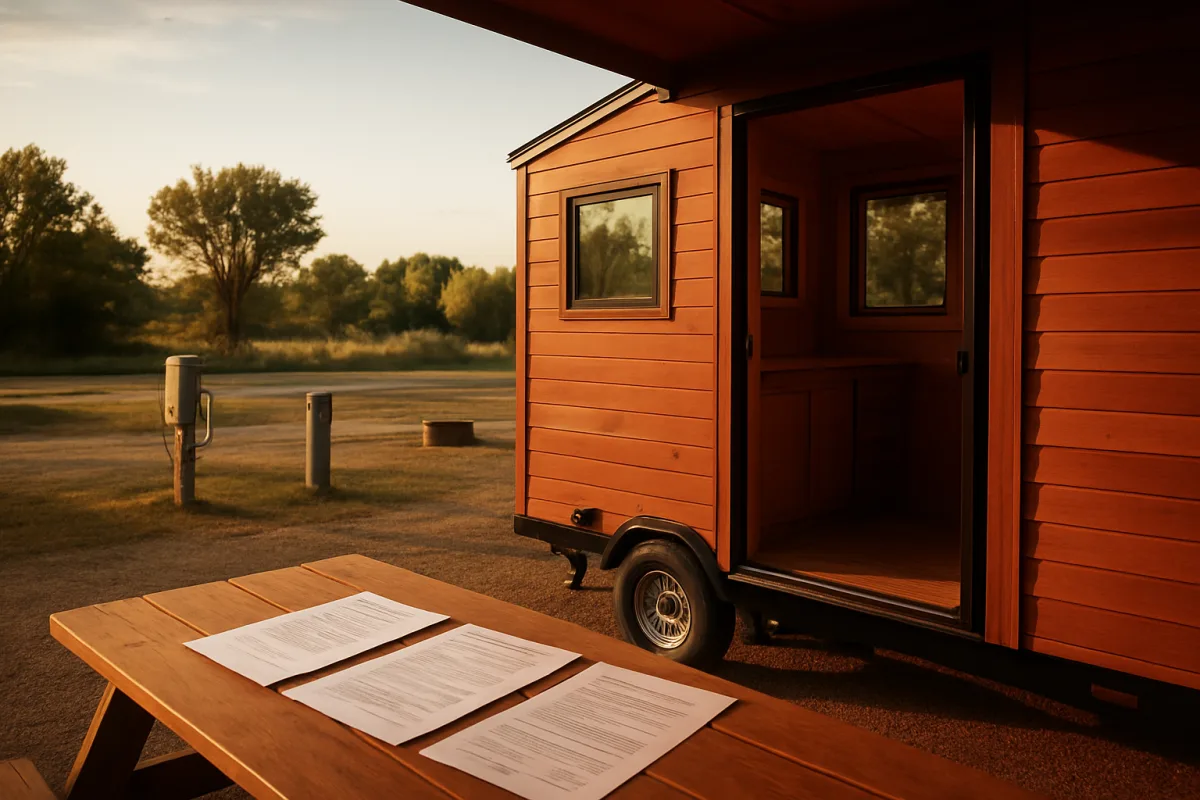
Financing a Tiny Home: Why the Loan Type Matters More Than the Sticker Price
The central problem: a tiny home is not always real estate
The financing problem starts with a deceptively simple question: what, legally and financially, is the thing you are buying? A conventional house sits on land, is permanently attached to it, and is recorded as real property.
A tiny house on wheels, often shortened to THOW, may look and function like a home. But lenders frequently see it more like an RV or other movable personal property. That classification shapes the loan, its rate, term, down payment, insurance, and resale assumptions.
This is why two small homes with similar floor areas can produce entirely different monthly payments. A 500-square-foot cottage on an owned lot may qualify for a mortgage. A 500-square-foot tiny house on a trailer parked in a rented community often will not.
Tiny House Talk’s financing guide puts the lender’s concern plainly: banks prefer collateral they can value and resell. A conventional house has local sales comparisons, land underneath it, and a familiar foreclosure process. A one-off trailer home has fewer of those safeguards.
For a buyer, that means the build itself is only one part of the approval process. The lender also cares about who built it, whether it meets a recognized standard, whether it can be insured, whether it has a title or registration, and where it will live.
How certification becomes a financial gatekeeper
RVIA certification is one of the most consequential labels in the tiny-house market. It means a tiny house on wheels was built to the RV industry’s NFPA 1192 standard, rather than being treated solely as a custom trailer project.
Some lenders also accept inspection or certification from NOAH, the National Organization of Alternative Housing. Acceptance is not universal, however. Buyers need to ask the prospective lender, in writing if possible, exactly which standards it recognizes. [1]
The builder, inspector, lender, insurer, and parking location all become part of one chain. If any link does not fit the lender’s rules, financing can stall even when the borrower has adequate income and a good credit history.
Certification does not make a tiny house equivalent to a site-built home. It may instead make it financeable as an RV. That can be useful, but it also means the home may depreciate more like a vehicle than appreciate like a conventional house.
Research summarized by Explore Tiny House estimates that tiny homes on wheels can lose roughly 40 to 50 percent of their value over six to eight years. Foundation-based tiny homes on owned land have a different pattern, with reported five-year appreciation of 80 to 110 percent. [5]
Those broad estimates are not guarantees, and resale remains highly location-dependent. Still, they explain why lenders hesitate to offer a 30-year mortgage on a movable custom home: the collateral may be worth substantially less before the loan is paid down.
What a $96,000 tiny home can really cost each month
A retired owner featured by Tiny Home Tours offers a useful real-world example. She bought a completed tiny home from Virginia builder Compass Tiny Homes for $96,000, then paid $10,000 to have it shipped to Durango, Colorado.
That makes the known house-and-delivery cost $106,000. It does not include the cost of a land purchase, a foundation, site work, permits, utility connections, insurance, furnishings, or ongoing community rent. Those omissions are where many tiny-home budgets become misleading.
She rents a lot at Island Cove, a Durango tiny-home community, for $865 a month, with utilities excluded. Her situation shows the trade-off clearly: the home made residence in a high-cost Colorado market possible on a fixed income, but it did not eliminate housing payments.
Suppose a buyer puts 10 percent down on that $106,000 total. The down payment is $10,600, leaving $95,400 to finance. Buyers should also expect possible lender fees, insurance requirements, and registration-related costs, none of which are included in this simple illustration.
For a new RVIA-certified tiny home, an RV loan around 7.25 percent is a reasonable broad 2026 benchmark, though actual quotes vary by borrower, lender, term, and home. [1] At that rate, $95,400 financed over 20 years works out to roughly $754 per month.
Add the $865 lot rent from the Tiny Home Tours owner’s community and the household is already at about $1,619 a month. That is before electricity, water, propane, internet, insurance, maintenance, and any vehicle payment or health-related expenses common in retirement budgets.
A 15-year term at the same assumed rate would raise the loan payment to roughly $871 monthly. The buyer would pay less interest over time, but their combined loan-and-lot-rent obligation would rise to about $1,736 before basic household operating costs.
That is the reason long terms can be tempting. They reduce the headline monthly payment. But a 20-year loan on a home that may depreciate puts the borrower at risk of owing more than the home could sell for, particularly in the earlier years.
Why an uncertified build can cost more, even when it costs less to buy
Now consider the same $95,400 financed with a personal loan rather than RV financing. Personal loans are based primarily on the borrower’s income and credit, not on the home as collateral, so they can fund a DIY or uncertified project.
The trade-off is rate and term. Personal loans for tiny-home borrowers commonly fall in an 8 to 15 percent range and may run for no more than seven years. [1] Tiny House Talk similarly warns that fees and high rates can make them expensive finish-the-project money.
At an illustrative 12 percent rate over seven years, financing $95,400 would require a payment of roughly $1,684 a month. Combined with the $865 lot rent in the Durango example, that is about $2,549 monthly before utilities or insurance.
That comparison explains why a certified $100,000 build can sometimes be more affordable month to month than an uncertified $75,000 build. The cheaper house may require a loan structure that consumes far more of a limited monthly income.
It also explains why many owner-built homes proceed slowly. Tiny House Talk profiles an off-grid owner who built with her carpenter father over approximately three years, using used doors and windows and spending an estimated $30,000 to $40,000 without a home loan.
Paying cash or building in phases avoids interest, but it creates a separate risk. A project can run out of money while exposed to weather or before plumbing, electrical work, insulation, and legal occupancy requirements are complete. A staged plan needs a protected stopping point.
The site is part of the affordability calculation
A lender may approve the home but not solve the question of where it can legally stay. Tiny houses on wheels are often classified as RVs, and many jurisdictions do not permit full-time RV occupancy outside designated parks or communities. [4]
Colorado rules vary by locality, despite the state’s popularity with tiny-home buyers. Zoning, utility requirements, building codes, park rules, and local enforcement can differ from one county or municipality to the next. A lender cannot make an unsuitable site legal. [4]
The Durango owner found five tiny-home communities, then secured a lot before her home arrived. That sequence is financially sensible. It avoids owning a finished house while scrambling for a legal place to park it, but it can mean paying rent before move-in.
Massachusetts offers a different example of how legislation and local implementation can diverge. The state’s Affordable Homes Act requires municipalities to allow at least one accessory dwelling unit, but implementation is gradual and Boston is exempt from the ADU provision. [3]
An ADU law also does not automatically legalize a tiny house on wheels in a backyard. A foundation-built small dwelling, a converted shed, an RV, and a trailer-mounted tiny home can fall under different rules. Buyers should verify the exact classification before borrowing.
The expenses that do not disappear after move-in
Small homes can reduce utility use, but not every small home is cheap to operate. The owner featured by Tiny Home Tours uses propane for hot water and cooking, plus grid electricity and water. Her bills are lower because of the small space, not nonexistent.
A fully off-grid system changes the timing of costs rather than making them vanish. Research estimates solar systems at roughly $8,000 to $18,000, water systems at $1,500 to $10,000, and heating systems at $1,500 to $4,000. [1]
That can be a sensible capital investment for the right rural site, but it is not a free utility plan. Batteries, pumps, filtration, propane equipment, backup generation, and internet service all require upkeep. Reliable monthly maintenance averages are not well established.
Internet alone can run roughly $45 to $120 monthly for off-grid homes, depending on service and location. [1] That matters for retirees who need telehealth access, remote workers, and anyone relying on a connection for banking, family contact, or emergency information.
Insurance also varies more than many first-time buyers expect. Specialty tiny-home policies are estimated at roughly $400 to $1,800 annually, depending on coverage, location, construction, and whether the home is stationary or moved. [2]
There is no reliable published premium for the particular $96,000 Durango tiny home shown by Tiny Home Tours, so it would be irresponsible to plug in a precise figure. The relevant lesson is to obtain a quote before closing, not afterward.
Property taxes can be modest for a trailer home classified as personal property, but classification and local assessment matter. Using Colorado’s statewide average property-tax rate of 0.49 percent, a $96,000 assessed value would suggest about $470 annually, not a guaranteed local bill. [1]
A fixed-income buyer needs a different affordability test
A lender’s approval is not the same thing as affordability. Lenders use debt-to-income ratios, credit scores, documented income, and down-payment funds. In 2026, tiny-home financing commonly expects credit scores around 620 or higher and down payments of 5 to 20 percent. [1]
A fixed-income household should also calculate a “bad month” budget. Use the loan payment, lot rent, utilities, insurance, food, transportation, medical costs, phone and internet, plus a repair reserve. Do not build the plan around unusually low utility bills.
The Tiny Home Tours owner’s decision makes sense in context. Conventional homes in her Durango area were beyond her means, while a smaller home and rented lot created a route to remain in a place she wanted to retire, near a workable community.
But her $96,000 purchase was not a bargain in the simplistic sense often implied by tiny-house marketing. It was a deliberate exchange: a lower entry cost than a local conventional house, in return for lot rent, limited resale certainty, and a home financed outside the mortgage system.
Before signing, ask three parties the same question: the builder, lender, and parking provider. Ask whether the exact model, certification, insurance policy, and intended full-time location are acceptable. A matching answer from all three is more valuable than a low advertised base price.
Frequently Asked Questions
Why is financing a tiny home on wheels different from a traditional mortgage?
A tiny home on wheels is usually classified as an RV or personal property rather than real estate. This means lenders treat it like a vehicle, resulting in higher interest rates, shorter loan terms, and larger down payments compared to conventional mortgages for site-built homes. The lack of land ownership and standard resale comparables makes lenders more cautious.
How does RVIA certification affect tiny home loan options?
RVIA certification means the tiny home meets the RV industry’s NFPA 1192 standard, making it eligible for RV-style financing with longer terms (up to 20 years) and lower interest rates (around 7.25%). Without certification, buyers often must rely on personal loans with higher rates and shorter terms, as uncertified homes lack recognized standards for lenders.
What are typical monthly costs when financing a tiny home?
For a $106,000 tiny home on wheels with a 10% down payment, a 20-year RV loan at 7.25% interest results in roughly $754 monthly payments. Adding lot rent—such as $865 per month in the example community—raises the total to about $1,619 before utilities, insurance, maintenance, and other expenses. Shorter loan terms increase monthly payments but reduce total interest paid.
Why do uncertified tiny homes often cost more to finance?
Uncertified tiny homes usually require personal loans instead of RV loans. Personal loans are based on income and credit without home collateral, leading to higher interest rates (8%–15%) and shorter terms (up to 7 years). This increases monthly payments and overall financing costs compared to RVIA-certified homes.
How does lot rent impact the overall affordability of tiny homes?
Lot rent can be a significant monthly expense that adds to the cost of financing a tiny home. In the example given, lot rent of $865 nearly doubles the monthly housing-related payments when combined with loan repayments. Affordability depends on whether the combined loan and lot rent payments leave enough income for utilities, insurance, maintenance, and other living expenses.
How we researched this
This article was assembled from 1 video source, 1 published article, 6 cited references.
Nothing here is based on hands-on testing. Where a figure or finding appears, it belongs to the source cited beside it, and the writing says so rather than implying otherwise. Every source is listed below so you can check it.
Sources
On a Fixed Income, a $96K Tiny Home Was Her Way To Retire — Tiny Home Tours
How People Actually Pay for a Tiny House: Every Option — Tiny House Talk
Tiny Home Loans in Colorado | 2026 Estimated Rates & Lenders | TinyHomeList
Tiny Home & ADU Zoning Laws in Massachusetts (2026 Guide) | Tiny Homes Zoning
Colorado Tiny House Laws (2026 Overview) | Prefabricated.co Blog | Prefabricated
Tiny House Depreciation Value Over Time: What Tiny Homeowners Need to Know in 2026
Watch Financing and Affordability Challenges for Tiny Homes on Youtube
Related Articles
Tiny House Living Stories
Explore tiny house living stories and downsizing experiences with real cost, layout, and lifestyle insights from long-term tiny home residents.
Prefab Tiny Home Kits Cost Breakdown and Features
Explore prefab tiny home kits cost breakdown under $100K, including features, installation, and financing challenges for buyers.
Tiny Home Build Costs Breakdown
Explore a detailed tiny home build costs breakdown, including site prep, financing, and budgeting tips for self-built tiny homes.
Tiny Home Financing Options: Loans and Market Insights
Explore tiny home financing options, loan types, certification impact, and market insights to help you buy your tiny house smartly.