
Prefab Modular Tiny Home Comparison
Compare prefab modular tiny homes Samara XL8 and LG Monocore 72 for layout, features, pricing, and suitability as backyard ADUs.
The 800-square-foot backyard home
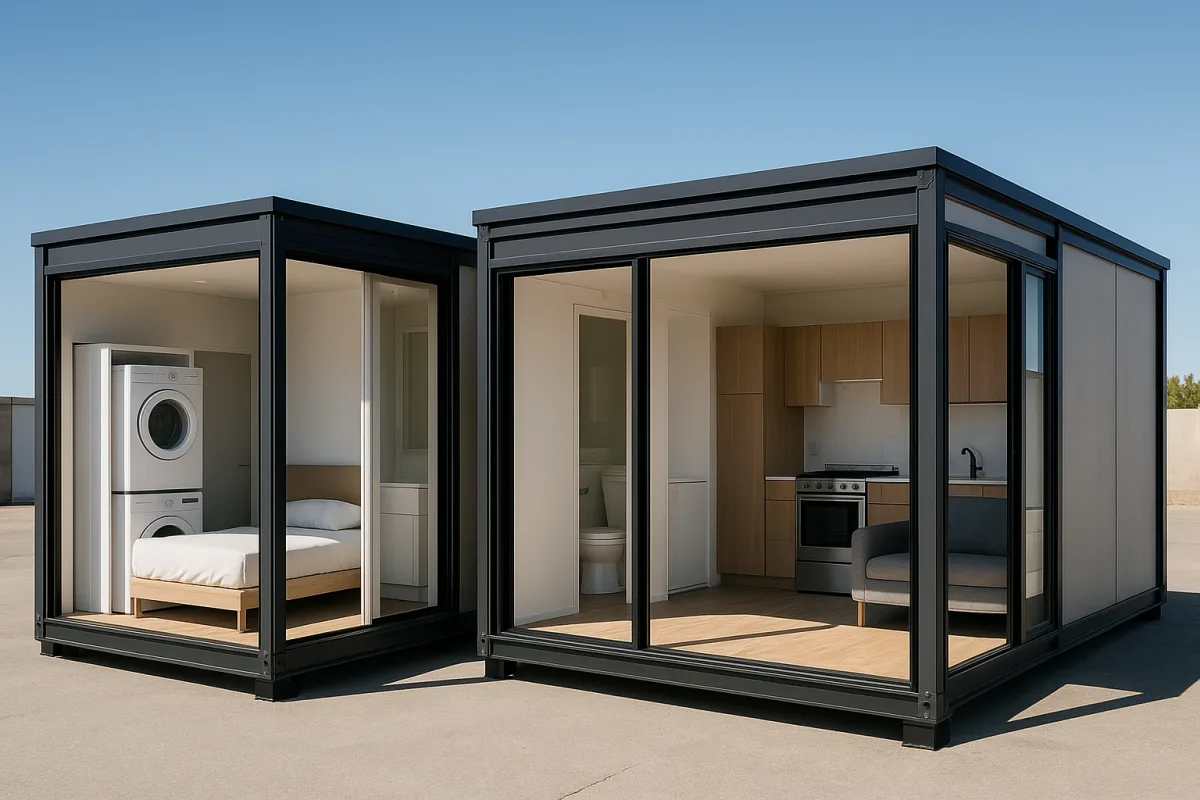
A side-by-side washer and dryer, two real bedrooms, and a second bathroom change the way an 800-square-foot home works. Those features are why Samara’s XL8 is closer to a compact permanent home than a weekend tiny house.
The XL8 is a two-bedroom, two-bath steel-frame prefab ADU from California company Samara. Kerry Tarnow toured one in Healdsburg, California, where it arrived in two factory-built sections and was joined on site.
Samara places the living room and kitchen at the front, then puts bedrooms, bathrooms, and laundry through the middle and rear. It is a familiar plan, but it avoids the common ADU mistake of treating storage and laundry as afterthoughts.
LG’s Monocore 72 takes a similar amount of floor area, about 785 square feet, and organizes it differently. The South Korean prefab has two bedrooms at one end, one bathroom and laundry near the center, then an open living room and kitchen behind a large front window.
These are close competitors on paper. One is a steel-frame California ADU designed for a specific market, while the other is a Korean smart cottage that treats automation and large glazing as key selling points.
Our pick: Samara XL8, for buyers who need a California ADU now
We would choose the XL8 if you have a California property and want a second dwelling for family, long-term rental, or a downsizing parent. Samara is selling it in California now, and the two-bath layout gives it a clear edge for daily use.
The XL8 starts at $249,000 for the base unit, plus installation, according to Kerry Tarnow’s tour of the Healdsburg home. Samara’s price does not include the site-specific work determined after a site visit, including the work needed to place and connect the unit. [1]
That sticker price is high, but it belongs in context. EVO ADU lists a 350-square-foot Compact studio at $145,800 for the home, with delivered and installed projects starting at $189,540, while Abodu’s 385-square-foot Studio is listed at $234,800 and typically costs $298,800 all-in. [1]
Those examples do not establish an installed XL8 price. They do show why you should ask for a site assessment before treating a prefab’s base price as your final budget, particularly on a sloped lot or a property needing long utility runs.
Samara XL8 vs. LG Monocore 72
| Criterion | Samara XL8 | LG Monocore 72 |
|---|---|---|
| What it is | California steel-frame backyard ADU delivered in two sections | South Korean prefab in LG’s Smart Cottage line |
| Size and rooms | 800 square feet, two bedrooms, two bathrooms | About 785 square feet, two bedrooms, one bathroom |
| Layout | Living room and kitchen at the front, private rooms and laundry behind | Bedrooms at one end, bathroom and laundry in the middle, living and kitchen at the other |
| Everyday storage | Coat closet, pantry or linen cabinet, laundry storage, and built-in bedroom dressers and wardrobes | Entry storage, laundry cabinet, and built-in bedroom wardrobes with drawers and shelving |
| Kitchen | Full-size refrigerator, electric range, dishwasher, 29-inch sink, drawers, and substantial upper cabinets | Multiple refrigerator and freezer compartments, dishwasher, cooktop, microwave, drawers, and a coffee-bar counter |
| Bathrooms | Main bathroom has tub-shower combination, primary bathroom has walk-in shower | One fully tiled bathroom with walk-in shower |
| Exterior and structure | Steel frame, fiber-cement siding, standing-seam metal roof, enclosed eaves | Wood-plastic-composite siding, metal roof, peaked-roof form, large living-room window |
| Smart features | No comparable whole-home smart system described | LG ThinQ controls for lighting, temperature, blinds, curtains, appliances, and other connected features [7] |
| Quoted price | Starts at $249,000 for the base unit, installation extra | Starts at 199 million Korean won, about $150,000 when Tarnow visited, with shipping, installation, and North American pricing unannounced |
| Main limitation | The base price is already substantial before site work and installation | No published North American sales, delivery, code pathway, or energy-use data |
1. Layout and day-to-day livability
The XL8 wins for a household of more than one adult. Two bathrooms keep mornings from becoming a scheduling exercise, and the separation between the main bedroom and living room gives an occupant some privacy when the second bedroom becomes an office or guest room.
Its hall does real work. Samara fits in a stackable laundry pair, folding counter, cabinets, hanging storage, a coat closet, and a tall cabinet that can serve as pantry or linen storage. That is the kind of infrastructure that makes small square footage last.
The Monocore 72 is open and bright, with a large living-room window, high ceilings, and an L-shaped sofa layout in the toured model. Its second bedroom was staged as an office, which is likely how many buyers would use it.
LG also builds storage into both bedrooms and gives the entry a tall bank of cabinets for shoes, cleaning gear, and outerwear. Still, one bathroom limits flexibility if two people work from home or if the second bedroom regularly hosts overnight guests.
We would take the XL8 layout. It gives up some visual drama, but it offers the better compromise for long-term occupancy, multigenerational living, and an ADU rented to a small household.
2. Kitchen, laundry, and storage
Neither manufacturer treats the kitchen as a token kitchenette. The XL8 has a full refrigerator, dishwasher, electric range, upper cabinetry, drawers, a 29-inch sink, and pull-out cabinet organizers that reach the rear of deep base cabinets.
LG’s kitchen is the more technology-heavy version. Tarnow found separate refrigerator and freezer sections with doors that close automatically, plus a dishwasher, cooktop, microwave, pull-out drawers, and smart-home control tablet.
The LG package will appeal if connected appliances and app controls are part of your routine. LG’s Smart Cottage system is built around the ThinQ ecosystem, including app-managed lighting, blinds, connected appliances, locks, and CCTV. [7]
But the XL8 has better support space around its functions. Its dedicated laundry counter and flexible hall cabinet make it easier to keep towels, detergent, pantry goods, and cleaning supplies out of the living area.
3. Structure, exterior, and climate concerns
Samara’s steel frame, fiber-cement siding, standing-seam metal roof, and tight eave treatment are aimed at a Class A fire-rated assembly. Tarnow noted that the home’s lack of projecting eaves contributes to that fire-focused exterior.
For a California property in or near a Wildland-Urban Interface area, that approach may be a major advantage. California Chapter 7A can require noncombustible siding, Class A roofing, enclosed eaves, and dual-pane tempered windows in these zones. [3]
You still need to verify the requirements at your address. Factory-built modular homes are generally inspected under state and local rules, often the IRC or IBC, rather than under one nationwide prefab code. [2]
LG’s peaked roof, composite cladding, black window trim, and large glass wall make the Monocore feel more house-like from the street. The glass is impressive, but more glazing can bring privacy, overheating, and window-covering demands depending on orientation and climate.
LG describes its cottage line around energy and HVAC technology, but it has not published Monocore 72 energy-consumption figures or clear off-grid capabilities. If solar production, battery size, heating load, or backup power decides the purchase, those missing specifications need answers before any deposit.
4. Price and what the price leaves out
The difference between $249,000 and roughly $150,000 looks decisive. It is not, because the quotes describe different markets and neither number represents a completed American project with land, foundation, delivery, permits, utilities, and local installation included.
Samara’s number is a confirmed California base-unit starting price. Installation comes on top, and a site visit determines its cost. [1] You should budget separately for foundation or crawl-space work, trenching, utility hookups, permit fees, landscaping repair, and access for delivery equipment.
LG’s quoted 199 million Korean won price came from Kerry Tarnow’s South Korea tour. It does not tell a U.S. buyer the shipping price, import and local installation cost, permit path, or final utility connection requirements.
This is where the XL8 pulls ahead despite the higher starting number. You can begin the California process with a builder already working in that market, while the Monocore is still an appealing concept with too many North American blanks.
Where container homes fit instead
A shipping-container home belongs in a different price and space category. Prefab Homes and Tiny House highlighted the 160-square-foot Zion ALT 20-foot container home from Alternative Living Spaces at $39,995, with a bathroom, plumbing, and electrical work inside the unit.
That price buys a compact one-bedroom arrangement in a single 20-foot container, not a two-bedroom small house. The channel also listed Bob’s Containers models such as the Abilene at $45,357, Beaumont at $47,544, and Cleveland at $47,675, all aimed at basic living or rental use.
The lower container price is attractive, but the site bill remains. Foundation or pad work, transport, crane placement, hookups, permits, land, and climate upgrades can change the total sharply. Conventional mortgages are also uncommon for container homes below $50,000, and appraisals can be difficult where comparable sales are scarce. [4] [5]
For a more design-led steel modular option, Hive Modular’s Model X is a one-bedroom, one-bath home made from three 8-by-20-foot modules. Kerry Tarnow toured the Philippines prototype, priced at 7.5 million pesos, or $117,280, including its 15-square-meter deck.
Hive’s Model X has an appealing open room, skylight, reclaimed hardwood flooring, built-in bedroom storage, and an exterior utility room that preserves indoor floor area. Its steel frame was designed for winds up to 255 kilometers per hour, according to the builder’s presentation.
Hive told Tarnow it expected North American deliveries within 14 months, but imported modular homes face local code, zoning, shipping, and installation hurdles. Until a North American price, delivery process, and approval path are published, we would not plan a project around that timetable.
Who each option suits
Choose the Samara XL8 if you own or are buying a California property and need a high-functioning backyard ADU. It suits a small family, two adults sharing the home, aging relatives, or a long-term tenant because two bathrooms, laundry, built-in storage, and separated bedrooms support ordinary routines.
It falls down for a budget-first build. The $249,000 base price excludes installation and site expenses, so it makes most sense when the property, local demand, and your intended use justify a substantial all-in project.
Choose the LG Monocore 72 if smart-home controls, a brighter living area, and a one-bath two-bedroom layout fit your life, and you are in a market where LG offers it with a documented installation route. It would suit a couple, a solo owner who wants a dedicated office, or a compact vacation home.
It falls down for a North American buyer who needs certainty. The price shown in South Korea is not a delivered U.S. price, and LG has not published the Monocore 72’s American availability, installation package, or detailed off-grid performance.
Choose a 20-foot container home if your real target is a guest suite, backyard office, short-term rental, or very compact solo home. A lower base price can leave room for site work, but only if you price delivery, hookups, permits, insulation, and financing before you commit.
Watch Hive’s Model X if you like steel modular construction with more architectural character than a basic container conversion. Its 480-square-foot plan makes sense as a one-person home or high-design retreat, but it remains a wait-and-verify proposition for North American buyers.
Frequently Asked Questions
What are the differences between Samara XL8 and LG Monocore 72 prefab homes?
The Samara XL8 is an 800-square-foot California steel-frame ADU with two bedrooms and two bathrooms, designed for local code compliance and fire resistance. It features a traditional layout with living and kitchen at the front and private rooms behind. The LG Monocore 72 is a South Korean smart cottage with about 785 square feet, two bedrooms, and one bathroom, emphasizing smart-home automation and large windows. Pricing and North American availability are clear for Samara but unconfirmed for LG.
Which prefab modular tiny home is better for California backyard ADUs?
The Samara XL8 is better suited for California backyard ADUs because it is currently available in California, meets local fire-conscious exterior standards, and offers two bathrooms and laundry facilities, which improve daily livability. LG’s Monocore 72 lacks published North American sales, installation, and code compliance details, making it less practical for California buyers at this time.
How do prefab modular tiny homes compare in layout and livability?
Both homes use around 800 square feet effectively, but the Samara XL8’s two-bathroom layout and dedicated laundry space provide more convenience for multiple occupants or long-term living. Its hall includes storage and functional cabinetry, supporting everyday use. The LG Monocore 72 has an open, bright design with one bathroom, which may limit flexibility for households with guests or multiple workers.
What are typical costs involved in prefab modular tiny homes beyond base price?
Beyond the base price, significant costs include site-specific work such as land preparation, permits, utility connections, and installation. For example, the Samara XL8 base price starts at $249,000, but installation and site work costs are additional and determined after a site visit. Similar prefab ADUs show that total delivered and installed prices can be substantially higher than the base unit cost.
What smart home features are available in modern prefab tiny homes?
The LG Monocore 72 includes an advanced smart-home system called LG ThinQ, which controls lighting, temperature, blinds, curtains, and appliances. In contrast, the Samara XL8 does not offer a comparable whole-home smart system. Smart features vary widely depending on the manufacturer and model.
How we researched this
This article was assembled from 4 video sources across 2 channels, 7 cited references.
Nothing here is based on hands-on testing. Where a figure or finding appears, it belongs to the source cited beside it, and the writing says so rather than implying otherwise. Every source is listed below so you can check it.
Sources
Inside New Prefab Home with a Layout that Just Makes Sense!, Kerry Tarnow
Inside LG's Brand New Prefab Home!, Kerry Tarnow
I Went to Manila to See a Prefab Home Built for Typhoon Winds!, Kerry Tarnow
7 Cheap Container Homes Under $50K With Real Plumbing, Power & Bathrooms, Move-In Ready, Prefab Homes and Tiny House
Prefab ADU Prices in California (2026): EVO vs Abodu vs Samara | EVO ADU
Are Prefab Homes Safe? Codes, Risks, and Exceptions - LegalClarity
Small shipping container house: costs, designs, and buying guide 2026
I spent a day in LG's Smart Cottage - is this the future of smart homes?
Watch Innovative Prefab and Modular Tiny Home Designs on Youtube
Also from the sources
Related Articles
Prefab Modular Tiny Homes Compared
Compare prefab modular tiny homes with innovative layouts like Samara XL8 and Wind River Nova to find the best fit for your living needs.
Two-Bedroom Tiny Homes: Family-Friendly Small House Options
Explore two-bedroom tiny homes with family-friendly layouts, pricing, and design tips for practical small-space living.
Modern Modular Tiny Home Designs
Explore modern modular tiny home designs, including layouts, costs, financing, and cold-climate considerations for compact, factory-built homes.
Park Model Tiny Homes Comparison
Compare park model tiny homes Durango and Outpost by price, layout, and unique features to find the best fit for your small-space living needs.