
Portable Solar Power for Tiny Houses
Learn how to size portable solar power systems and batteries for tiny houses to ensure reliable backup during outages and off-grid living.
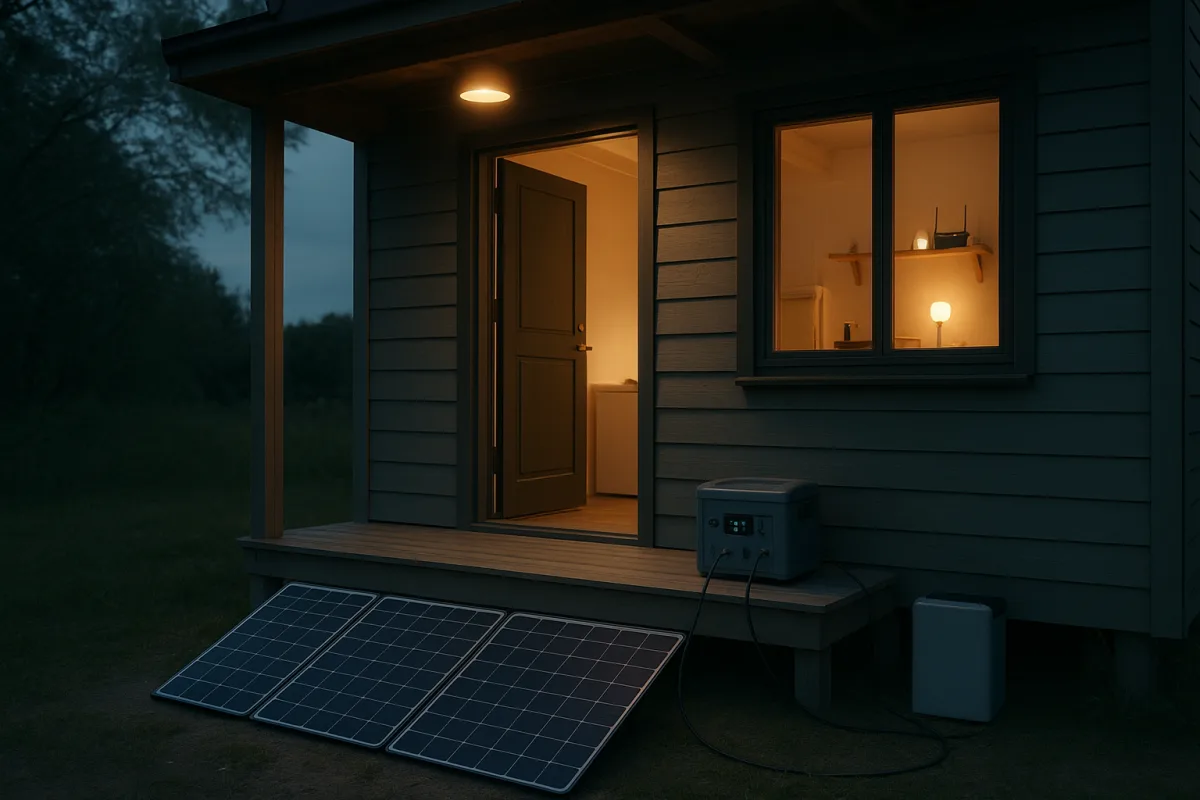
Solar Backup for a Tiny House Starts With Watt-Hours, Not Panel Watts
The number that matters is watt-hours
Portable solar marketing tends to lead with panel wattage. A folding panel may be rated at 100W, 200W, or 400W, while a power station might advertise a 3,072Wh battery and a 3,600W output. Those are different measurements.
Watts describe the rate at which electricity is being used or produced at a given moment. Watt-hours describe stored or consumed energy over time. For a tiny house owner planning backup power, watt-hours are usually the more useful starting point.
Think of watts as the width of a pipe and watt-hours as the amount of water in a tank. A wide pipe can deliver a lot quickly, but it tells you nothing about how long the tank lasts.
A battery’s output rating matters because it determines what can run at once. Its capacity matters because it determines how long those loads can keep running. Mixing up the two is how people buy an impressive-looking unit that cannot meet their actual needs.
The practical calculation is simple: appliance watts multiplied by hours used equals watt-hours consumed. A 10W LED light used for five hours consumes 50Wh. A 60W laptop used for four hours consumes 240Wh.
A compact refrigerator is harder to estimate because its compressor cycles on and off. But a refrigerator, router, several lights, phones, and laptop charging are realistic backup loads. Electric space heat, induction cooking, clothes drying, and air conditioning are much less forgiving. [3]
That distinction is important in a tiny home, where the house may be physically small but still contain ordinary household appliances. Square footage does not automatically equal low electricity use.
Start with the outage you are trying to survive
The case for a battery is not necessarily permanent independence from the grid. It may simply be keeping food cold, phones charged, lights on, and communications working through a weather-related outage.
The U.S. average outage reached roughly 11 hours in 2024, according to the reporting synthesized by Inhabitat, with major hurricanes accounting for most lost hours. Shorter routine outages averaged about two hours. That is a very different design target from a week off-grid.
For a two-hour outage, a modest portable battery may be plenty. For a three-day outage, the battery capacity, refrigerator consumption, solar recharge window, weather forecast, and disciplined appliance use all start to matter.
Tiny Home Tours featured a Durango, Colorado resident using a Bluetti Elite 400 power station as backup in her tiny house community. The channel states that the unit has 3,800Wh of capacity and a 2,600W rated output.
The channel’s claim that it can run a standard refrigerator for more than three days should be treated as a favorable estimate, not a universal result. Refrigerator energy use varies substantially by model, room temperature, door opening, and compressor cycling.
The same Bluetti unit is presented as being chargeable from a wall outlet, vehicle, generator, or solar panels. That flexibility is useful, but it does not remove the need to calculate energy. Charging options are not the same as having enough energy available.
Bluetti did not provide a price in the supplied Tiny Home Tours material, so there is no defensible sticker-price comparison to make here. It suits someone who wants a rollable, high-capacity outage battery for essential loads rather than a permanently installed solar system.
Why a 3,000Wh battery is not a tiny-house power plant
The EcoFlow Delta 3 Ultra, cited in the research brief, is rated at 3,072Wh with a 3,600W output. That higher output means it can support more demanding individual appliances than lower-output stations, assuming surge requirements are also met. [3]
Its capacity is roughly equivalent to 3.1kWh. In simplified terms, it could theoretically supply 100W for about 30 hours, 500W for about six hours, or 1,500W for around two hours before conversion losses.
Real results will be lower because power stations use electricity to run their inverter, screens, cooling fans, and internal electronics. AC-powered appliances also lose some energy through conversion from the battery’s DC electricity.
That is why a hair dryer can be technically compatible with a large power station but still be a poor outage choice. A 1,500W hair dryer can consume around half of a 3,000Wh battery in an hour, before losses.
The power station may run it because the output rating is high enough. The question is whether running it is a sensible use of stored energy when the same battery may need to preserve food and internet access overnight.
EcoFlow’s Delta 3 Ultra suits a tiny-house resident who needs high output for short, occasional loads while maintaining a larger reserve for essentials. The supplied research names its capacity and output, but does not provide a price, so it should not be compared by cost here. [3]
The same limitation applies to the Jackery models mentioned in the research brief. The brief establishes that their capacities and outputs differ from the EcoFlow unit, but identifies neither specific models nor prices. A useful purchase comparison requires both.
That may sound overly cautious, but capacity labels alone can mislead. Some models quote expansion-ready capacity, some quote base battery capacity, and some package deals include panels while others do not.
Solar panels determine recovery, not runtime
A solar panel does not make a battery larger. It determines how quickly the battery can recover after use, assuming there is usable sunlight and the panel is compatible with the power station’s input limits.
A 200W panel under ideal laboratory conditions can theoretically produce 200Wh in one hour. Outdoors, it rarely produces its nameplate rating continuously because panels heat up, clouds pass, sun angles change, and shade interferes.
As a practical planning range, a 200W portable panel might restore a few hundred watt-hours over a good day, not necessarily 1,000Wh. The Inhabitat reporting makes the same basic point: ratings come from standardized tests, while field output changes with weather and orientation.
That means a 3,000Wh battery paired with a single 200W panel may take several favorable days to refill from empty. It can still be valuable, but it is a backup system with solar assistance, not endless power.
The Renogy 200W 24V Mono N-Type panel is notable because the research brief places its efficiency at 25%, a strong figure for limited tiny-house roof area. [14] Efficiency matters most where panel footprint is constrained.
That Renogy panel suits a tiny-house roof or fixed ground mount where every square foot needs to earn its place. Its supplied information does not include a current price, so a cost comparison would require checking a retailer and confirming the exact model. [14]
High efficiency does not overcome shade. A roof panel partly shadowed by a tree, plumbing vent, chimney, or neighboring home can produce far less than its rating. In small homes, one bad shade line can affect a large share of the array.
Portable panels offer an advantage here. You can move them into sunlight while keeping the power station indoors. The trade-off is setup time, theft risk, cable management, and the fact that someone must reposition them as the sun moves.
Price the battery first, then the system around it
The attractive price of a panel is often the least expensive part of an off-grid build. Storage is the costly component because it has to hold enough energy for overnight use, cloudy weather, and the loads you consider non-negotiable.
Battery storage commonly costs around $800 to $1,500 per usable kWh, according to the research brief’s cost guidance. [13] A nominal 3kWh battery therefore represents a substantial share of the system budget before panels, cables, mounts, or installation.
A small do-it-yourself package can reduce labor costs, but it transfers responsibility to the buyer. You need to understand voltage, current, fusing, connector types, charge-controller limits, grounding, and the battery’s permitted solar input.
Professional installation costs more, yet it can be sensible where the system is roof-mounted, tied into household wiring, or expected to support a permanently occupied home. Electrical work has consequences beyond whether the lights turn on.
Tiny Home Tours provides a useful reminder that backup power is only one line item in a tiny-house budget. The Durango resident’s Compass Tiny Homes build cost $96,000, plus $10,000 shipping from Virginia, and her lot rent was $865 monthly before utilities.
That home uses grid electricity, water, propane for cooking and hot water, and a conventional flushing toilet. It is not an off-grid case, but it shows why many residents consider a portable battery before committing to a costly whole-house solar conversion.
Regulations and insurance can turn “portable” into complicated
A battery plugged into appliances is one thing. Solar equipment connected to a home’s electrical system is another. The latter may trigger permitting, inspection, utility, and insurance requirements depending on location and installation method.
The research brief flags NEC 2023 rapid-shutdown requirements as particularly important for photovoltaic systems. These rules are intended to reduce hazards for firefighters and emergency responders by quickly lowering voltage in specified rooftop solar conductors.
Do not assume a portable panel avoids every rule just because it folds up. Plug-in solar systems have been legalized or specifically addressed in some states, but state and local requirements vary widely. [7]
Before buying equipment, ask the local building department whether the intended setup needs a permit. Ask the insurer whether it must be disclosed, whether code compliance documentation is required, and whether a licensed installer is expected. [8]
Failure to disclose a solar installation or meet applicable requirements can create a coverage problem, according to insurance guidance summarized by TechRadar. [8] That is especially relevant for tiny homes, which may already occupy an awkward space between RV, manufactured-home, and dwelling rules.
Plan for replacement, not just purchase
Lithium iron phosphate, usually written LiFePO4, is widely preferred for stationary and portable storage because it offers a comparatively long service life and a better safety profile than some other lithium chemistries. That does not mean it lasts forever.
Budget for cleaning, inspections, repairs, and eventual inverter replacement. The research brief estimates annual cleaning at roughly $150 to $400 and inspections at $150 to $300, while inverter replacement after roughly 12 to 15 years may cost $1,500 to $3,000. [9]
Over five to ten years, maintenance and replacement costs may add roughly $2,000 to $4,000, plus any repairs. Those figures will vary with climate, dust, snow, roof access, equipment quality, and whether you can safely do basic upkeep yourself. [10]
The sensible small-space approach is not to chase total self-sufficiency on day one. Measure actual loads for a month, identify the essentials, buy enough battery for those essentials, then add solar recovery that matches your roof, sun, budget, and legal setup.
Frequently Asked Questions
How do I size a portable solar power system for my tiny house?
Sizing a portable solar system should start with calculating your daily watt-hour usage. Typical tiny houses consume roughly 500 to 1,500Wh per day. Multiply the wattage of each appliance by the hours used to estimate total daily consumption and size your battery and panels accordingly.
What watt-hours do I need for solar backup in a tiny home?
A typical tiny home uses between 500 and 1,500Wh daily. For backup purposes, focus on essential loads like refrigeration, lighting, and device charging rather than high-demand appliances like electric heating or air conditioning, which can quickly overwhelm a small battery.
Can a 3000Wh battery power a tiny house during an outage?
A 3,000Wh battery can provide meaningful backup for essentials such as refrigeration, lighting, and electronics but is not sufficient for whole-house off-grid living with electric resistance heating or air conditioning. It might supply 100W for about 30 hours or 500W for around six hours, but actual runtime will be less due to inverter and conversion losses.
How long does it take to recharge a portable solar battery?
The article does not provide specific recharge times for portable solar batteries. Charging speed depends on the solar panel wattage, battery capacity, and environmental conditions, so it requires calculation based on your specific setup.
What appliances can a portable solar generator run in a tiny house?
Portable solar generators can realistically run a compact refrigerator, router, several lights, phones, and laptops. High-demand appliances like electric space heaters, induction cooktops, clothes dryers, and air conditioners are generally not practical to run on typical portable solar batteries due to their high energy consumption.
How we researched this
This article was assembled from 1 video source, 1 published article, 14 cited references.
Nothing here is based on hands-on testing. Where a figure or finding appears, it belongs to the source cited beside it, and the writing says so rather than implying otherwise. Every source is listed below so you can check it.
Sources
On a Fixed Income, a $96K Tiny Home Was Her Way To Retire — Tiny Home Tours
The Evolution of Portable Solar Technology for a More Resilient Energy Future — Inhabitat
Global LCOEs of decentralized off-grid renewable energy systems
How Many Solar Panels for a Tiny House? (2026 Guide) | GreenEnergyCalc
Best Portable Solar Generators for Tiny Homes (2026) | Tiny Amazon Homes
Tiny Home Financing — RV Loans, Personal Loans & Mortgage Options (2026)
Plug-In Legislation: Bills Defining Portable Solar Propagate Across the Country — DSIRE Insight
Solar Panel Maintenance Cost in 2026: What You'll Actually Spend Over 25 Years | SolarSimple
How Much Does It Cost to Maintain Solar Panels? [2026 Data] | Angi
Solar Panel Maintenance Costs in 2026: Cleaning, Repairs & Long-Term Expenses - Best Solar Advice
Off-Grid Solar Kits for Tiny Homes: A Complete 2026 Cost Guide | Tiny Home Sherpa
Watch Solar and Portable Power Solutions for Tiny and Off-Grid Living on Youtube
Related Articles
Off-Grid Power Solutions for Tiny Homes: Sizing and Setup
Learn how to size and choose off-grid power solutions for tiny homes, including solar generators, battery storage, and backup power options.
Off-Grid Small Cabin Living for Families
Learn how to plan and design off-grid small cabin living for families, including layouts, power systems, and legal considerations.
Truck-Based Off-Grid Tiny Homes: Mobile Living Innovations
Explore truck-based off-grid tiny homes, their design, costs, and mobile living systems for self-sufficient life on the road.

Off-Grid Water Systems for Tiny Homes Explained
Explore off-grid water systems for tiny homes, including sourcing, costs, and management tips for sustainable living.