Mortgage-Free Tiny Living in Shipping Containers and Small
Explore mortgage-free tiny living with shipping containers, off-grid systems, costs, and legal tips for small-space homes.
The shift is real, but it is not mainly about containers
Mortgage-free tiny living is shifting from a niche idea about living with less stuff into a practical strategy for reducing fixed housing costs. The strongest examples are not necessarily the smallest or cheapest homes. They are projects where land, services and daily life have been planned together.
Three very different sources point in that direction. Tiny Home Tours profiled a 70-year-old owner who chose a tiny home because maintaining an older conventional house had become exhausting. Tiny House Talk documented a Queensland family using a container, shed and deck to live off-grid without a mortgage. Its legal guide also reflects the growing focus on placement and classification rather than square footage alone.
That is meaningful evidence of a change in priorities, although it is not proof of a mass housing-market transformation. Tiny homes remain a very small share of the overall housing market, and resale data is patchy, particularly for owner-built container projects. The trend is real at the household level, but claims that tiny houses are broadly replacing conventional housing would be overstated.[10]
What connects these households is not a particular floor plan. It is the wish to lower recurring obligations, reduce maintenance, and gain more control over time. That can mean retirement security, fewer work hours, time with children, or simply not spending every weekend repairing unused rooms.
Why mortgage-free appeals now
The appeal is clearer now because the costs of ordinary housing are not limited to a loan repayment. A larger house usually brings larger utility bills, more cleaning, more maintenance surfaces, more furnishings and, often, a greater dependence on paid help as owners age.
The Tiny Home Tours resident describes that trade-off without romanticising it. Her previous house had ageing wiring, constant painting and cleaning, and a workload that felt increasingly hard to manage. In the smaller home, she still has maintenance, but it is within reach: a small painting job rather than a summer-long project.
That distinction matters. Mortgage-free does not mean cost-free, and small homes do not stay maintenance-free. It means the owner may be able to understand, budget for and physically handle more of the work. For older buyers especially, simplicity can be as valuable as reduced floor area.
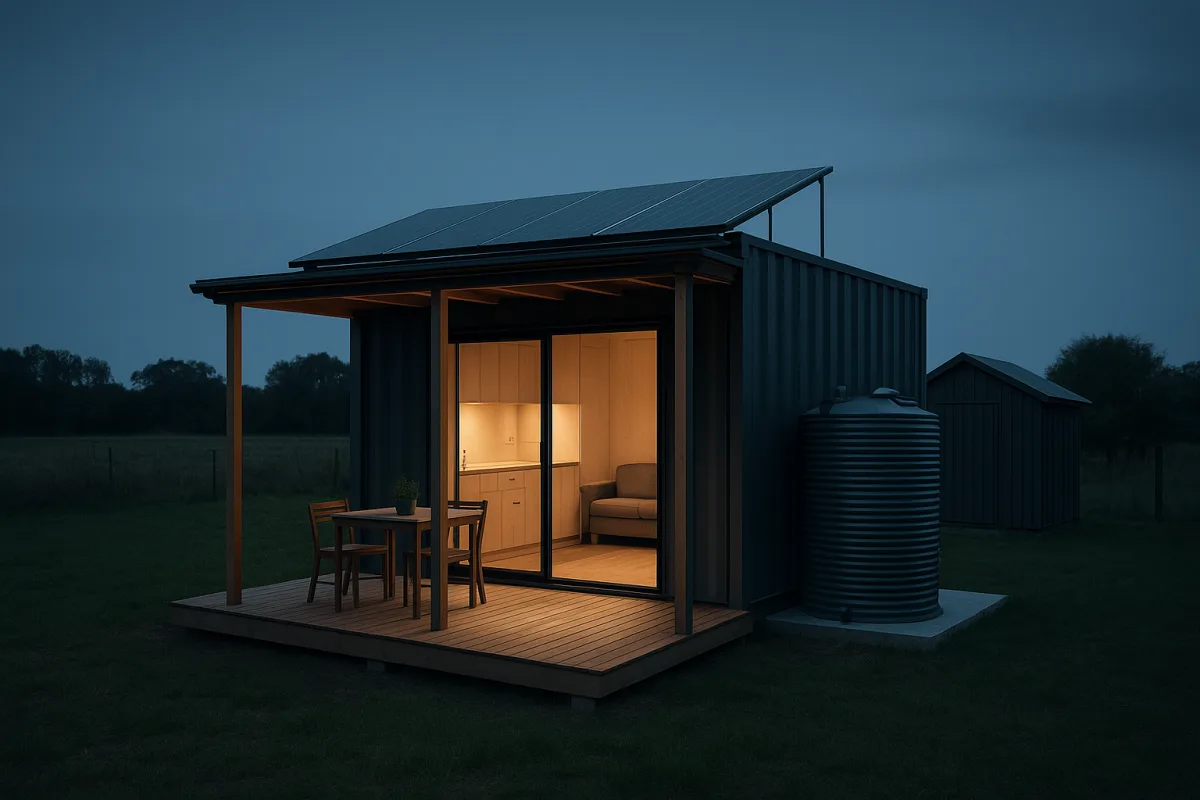
The same logic appears in the Queensland container project reported by Tiny House Talk. Ryan and Lorena, parents of two young children, were not chasing minimalism for its own sake. They wanted a lower-cost way to live on their own two acres, spend less time working to cover housing costs, and spend more time with their children.
Their project also shows why the phrase “container home” can mislead. The 20-foot container is only one part of the dwelling system. A shed holds wardrobes, laundry, office space, toys and creative work. A covered deck handles dining and lounging. The fire pit and outdoor kitchen reduce pressure on the compact interior.
A container is not automatically the low-cost option
The family told Tiny House Talk that its container, shed, deck and off-grid utilities cost roughly AU$55,000 to AU$60,000. Land cost AU$105,000, putting the stated all-in spend around AU$160,000 to AU$165,000, funded without a mortgage after selling an earlier tiny house.
That is an unusually useful real-world figure because it includes more than the steel box. It still needs careful interpretation. The owners did much of the work themselves, used help from friends and family, and did not keep detailed accounts. It also does not make their result a guaranteed price for another Queensland site.
Current Queensland estimates underline the variability. A used 20-foot high-cube container may cost roughly AU$3,520 to AU$8,030, but site preparation and foundations can run from AU$10,000 to AU$40,000. Structural changes, insulation, fit-out, permits, delivery and off-grid equipment can rapidly outweigh the container purchase.[9]
That is the less glamorous fact of container building: the container itself is typically only five to 10 percent of total project cost. The expensive work is cutting openings safely, preventing condensation, insulating properly, building bathrooms and kitchens, establishing services, and making an awkward industrial shell comply with residential rules.[2]
For a Queensland off-grid container project, broad estimates place total build and setup costs at roughly AU$41,000 to AU$117,000 before land, depending heavily on access, soil, finishes and how much work is contracted out. Those are planning ranges, not quotes, so obtain local prices before committing to a block.[11]
A cheap rural block can be expensive if the driveway is poor, the soil needs engineered footings, water is scarce, or a wastewater system is difficult to approve. The Tiny Home Tours resident makes a related point from the other direction: buying into an established tiny-home community can avoid the separate costs of a well, sewer, electrical connection, road and internet installation.
Off-grid is a trade, not an escape from bills
Off-grid living is increasingly part of the mortgage-free appeal because it can reduce dependence on monthly utility accounts. It also gives owners more control where grid connection is expensive or unavailable. But it replaces a predictable bill with equipment, maintenance and resource management.
The Queensland family intentionally chose an off-grid property. They use tank water and hope to add a bore later, acknowledging that drilling is costly. Their composting toilet, solar power and outdoor-oriented lifestyle suit the site, but the setup depends on climate and on their willingness to monitor limited systems.
A modest off-grid solar system with batteries is not a decorative add-on. Queensland estimates put a 3kW solar system with 10kWh of battery storage at about AU$12,000 to AU$18,000. Water storage, pumps, filtration, wastewater arrangements and heating can add substantially more.[9]
Across small off-grid builds, initial systems for power, water, waste and heating can add roughly US$18,000 to US$35,000 to base construction. Monthly costs may be lower than grid-connected housing, estimated around US$70 to US$180, but the evidence on long-term maintenance costs remains limited.[8][12]
Plan for solar-panel cleaning, battery replacement or servicing, pump repairs, filter changes, propane, water deliveries where needed, and heating checks. The project becomes more resilient when there is a backup plan for cloudy weather, a failed pump, a full composting toilet, or a week of heavy rain.
Small-space success depends on support space
The container project is also a warning against judging a home by its internal square footage alone. A family of four in a 20-foot container is possible, but only because much of the household lives outside or in the adjacent shed.
Inside, the family used a king bed at one end and added a slide-out children’s bed on wheels. They described stepping over the children to reach their own bed and constantly tidying. That is candid evidence that mortgage freedom may involve real daily compromises, not merely clever design.
For a single adult or couple, a compact home can be a very workable long-term arrangement. The Tiny Home Tours resident has tailored her kitchen around how she lives now: simpler meals, a compact dishwasher, accessible storage and a small dining table that expands when family visits.
Her choices are practical rather than fashionable. A sofa bed gives grandchildren somewhere to sleep, a table expands to seat four, and high ceilings and windows reduce the closed-in feeling. These are useful strategies, but they do not create extra square footage. They make limited space work harder.
Families should therefore budget for a covered deck, storage shed, guest cabin, carport or other legally permitted support space if the site and rules allow it. Those additions may make the home livable, but they also belong in the true project budget.
The legal category decides more than the style
The biggest planning mistake is treating “tiny house” as a legal description. It usually is not. Local authorities will classify the structure as a permanent dwelling, RV, park model, manufactured home, modular home or accessory dwelling unit, then apply the rules attached to that category.[3]
A container home on a permanent foundation is generally treated as a conventional residence. That can mean permits, inspections, zoning review, setbacks and code compliance. It is more work upfront, but it also offers clearer legal standing for year-round occupancy and better prospects for conventional insurance and financing.[6]
A tiny house on wheels often falls under RV rules, even when it looks like a cottage and has high-quality construction. RV certification can help with registration, insurance and access to RV parks, but it does not normally create a right to live full-time on private land.[4]
The distinction affects mortgage-free planning. A financed tiny house on wheels may be easier to buy with an RV or chattel loan, but those loans can carry higher rates and less favourable terms than a conventional mortgage. Personal loans are another route, usually with shorter repayment periods and higher rates.[7]
For buyers intending to own land and stay put, a permitted foundation-based small home often provides a more durable path. That does not mean it will be cheap. Many jurisdictions still impose minimum dwelling sizes of 600 to 1,000 square feet, which can rule out a genuinely tiny primary residence.[3]
Some places allow a small home more readily as an accessory dwelling unit, or ADU, on a lot with an existing primary house. Others allow permanent RV occupancy only in specific rural zones or approved parks. Ask the planning office direct questions before purchase, and get answers in writing where possible.
What this means for a practical project plan
Start with the life you want to fund, not the house you want to post online. A retiree who values easy upkeep, a remote worker needing quiet office space, and a family with two children may all want lower housing costs, but they need very different layouts and sites.
Price the project in layers: land, legal due diligence, access, earthworks, foundation, structure, delivery, utilities, permits, interior fit-out, appliances, outdoor living and contingency. If a builder quotes a base shell price, assume it excludes several of those layers unless the contract says otherwise.
Then choose the category with your exit plan in mind. Tiny homes on wheels can offer mobility and lower entry costs, but the resale market is narrow and RV-style units commonly depreciate. Foundation-based, code-compliant homes on owned land generally have stronger legal and resale prospects.[10]
Finally, be honest about what “mortgage-free” requires. It may mean savings, proceeds from selling a previous home, a period of owner-building, family labour, a less expensive region, or accepting a much smaller daily footprint. The attraction is not that tiny living erases costs. It is that it can make the costs, work and choices more manageable.
Frequently Asked Questions
How can I live mortgage-free in a shipping container tiny home?
Living mortgage-free with a container tiny home involves careful planning of land, site, and utility decisions rather than just focusing on the container cost. The Queensland example shows that combining a container with outdoor rooms like a shed and deck, and installing off-grid systems, can support a family living without a mortgage. Doing much of the work yourself and selecting affordable land also contribute to mortgage-free living.
What are the real costs of building a container home mortgage-free?
The total cost for a 20-foot container home, including shed, deck, and off-grid utilities, was about AU$55,000 to AU$60,000 in Queensland, with land costing around AU$105,000. More broadly, container purchase is only 5–10% of total expenses; site preparation, foundations, structural modifications, insulation, permits, and off-grid systems can raise costs significantly. Estimates for build and setup (excluding land) range from AU$41,000 to AU$117,000 depending on conditions and finishes.
What off-grid systems are needed for mortgage-free tiny living?
Essential off-grid systems include solar power (e.g., a 3kW system with a 10kWh battery), water storage, wastewater management, and backup heating. These systems reduce monthly bills but require upfront budgeting, as they are not just optional upgrades. Planning and funding these utilities separately from the container build is important for sustainable mortgage-free living.
How do zoning and permits affect mortgage-free tiny houses?
Zoning laws and permits significantly influence where and how tiny homes can be built and occupied. For example, tiny houses on wheels are often regulated as RVs and may only be allowed temporary occupancy, while container homes on permanent foundations can be treated as conventional residences subject to local building codes and zoning requirements. Checking local zoning before purchasing land or starting construction is crucial, as minimum dwelling sizes and other restrictions vary widely.
Can a family live comfortably mortgage-free in a small container home?
Yes, but it often requires supplementing the container with outdoor living spaces and separate utility areas. The Queensland family used a 20-foot container alongside a shed and covered deck to accommodate their needs, including space for children and daily activities. This approach helps compensate for the container’s limited interior space and supports comfortable family living.
How we researched this
This article was assembled from 1 video source, 2 published articles, 12 cited references.
Nothing here is based on hands-on testing. Where a figure or finding appears, it belongs to the source cited beside it, and the writing says so rather than implying otherwise. Every source is listed below so you can check it.
Sources
She Owns Her Tiny Home AND Land at 70, Retiring Right — Tiny Home Tours
A Family of Four Lives Mortgage-Free in a 20-Ft Shipping Container in Queensland — Tiny House Talk
Is Your Tiny House an RV or a House? Why It Decides Everything — Tiny House Talk
Build a House with 2 Shipping Containers! Easy Off-Grid Guide with Solar Power - Solar Container
How to Get a Tiny House: Zoning Laws, Permits, and Codes - LegalClarity
Tenant Rights in Tiny Homes and Alternative Housing: Complete Guide (2026) | ReadYourLease
Tiny House Zoning Laws: Where Tiny Homes Are Legal | Zonloty
Watch Mortgage-Free Tiny Living in Shipping Containers and Small Spaces on Youtube
Related Articles
Prefab Tiny Homes and ADUs
Explore prefab tiny homes and ADUs with modern designs, costs, legal tips, and site considerations for small footprint living.
Shipping Container Prefab Homes for Rural and Off-Grid
Explore shipping container prefab homes for rural and off-grid living, including costs, designs, and installation challenges.
Travel Writer's Tiny House Journey: Sustainable Living in Northern NSW
Join Louise, a travel writer, on her inspiring journey to build a charming tiny house in Northern New South Wales. Discover her sustainable design choices, cozy living spaces, and dedication to simplicity in this heartwarming story of resilience and creativity.

Sustainable Off-Grid Tiny House in Australian Bush: A Creative Haven
Explore Shane's off-grid tiny house in the Australian bush, showcasing sustainable living and recycled materials. The house features artwork, solar power, and clever design solutions for compact living.